
While Southwest is pretty honest and upfront about its flight attendant recruitment process, what it can’t tell you is how unpredictable the process actually, how little warning you get before a recruitment window opens and closes, or, most importantly, how to actually pass each stage.
That’s where this guide comes in. We’ve spent years immersed in flight attendant recruitment across the industry, and this guide walks through every stage of Southwest’s process in order, with the context, preparation resources, and honest detail that Southwest can’t tell you itself.
We keep this guide updated. Everything below reflects the process as it runs in 2026.
Recruitment Status
Southwest last opened external flight attendant applications in April 2026, and the airline is still working through that applicant pool. There’s no confirmed date for the next window, and Southwest doesn’t typically open a new one while an existing pool is still being processed.
Southwest currently has more flight attendants than its schedule requires, and a voluntary unpaid leave programme is running through April 2027, which is the main reason the next external window is unlikely before late 2026, and possibly not until 2027.
Worth knowing: Southwest has confirmed a new crew base opening at Austin-Bergstrom International Airport (AUS), adding more than 2,000 pilot and flight attendant jobs over time. That’s a longer-term growth signal rather than something that will speed up the current backlog, since for now those roles are expected to come largely from internal base transfers rather than new external hiring.
We’re actively tracking the status of Southwest flight attendant recruitment in detail in Is Southwest Airlines Hiring Flight Attendants?, which we update as the situation develops.
How You Apply
Southwest Airlines only accepts applications through its official careers website, and only during short application windows. There’s no Open Day and no walk-in option. To receive updates on when a window opens, you can also join the Talent Community, though it won’t automitcally submit an application for you when a recruitment window open – instead, you’ll still need to submit a full, separate application once a posting goes live.
What sets Southwest apart from almost every other major carrier is how briefly those windows stay open. Recent windows have run anywhere from around 38 minutes to about five hours before closing.
There’s a real Fear of Missing Out connected to Southwest flight attendant applications, which means that having your resume, tailored for this position, read to go, is really important.
Minimum Requirements
Before you apply, you need to meet all of the following:
- Age: 20 or older at the time of application.
- Right to work: Authorization to work in the United States under the Immigration Reform Act of 1986.
- Passport: A valid, unexpired passport.
- Education: High school diploma or GED required. College coursework or a degree is preferred but not required.
- Physical abilities: You’ll need to lift and lower objects up to 20 pounds into and from overhead bins unassisted, and lift or carry items up to 100 pounds (such as an emergency life raft) with assistance. You’ll also need to reach fully overhead, squat with your knees touching the ground, walk and stand for extended periods while carrying a full drink tray, move quickly through the cabin in an emergency, fit through the overwing window exit, and fit into a jumpseat harness without modification or a seatbelt extension.
- Water evacuation: You’ll need to be able to jump into water wearing a life vest and climb into a raft as part of an emergency evacuation drill.
Worth knowing: Southwest doesn’t publish a specific height or reach figure. Instead, the requirement is entirely functional: can you reach the overhead bins, fit through the overwing exit, and fit the jumpseat harness without an extension. That means there’s no number to measure yourself against beforehand, but it also means very tall, very short, or very broad candidates can be screened out by those functional checks even with no stated cutoff to warn them.
The Online Application
When you submit your application and resume through Southwest’s careers website, it’s screened by what’s known as an Applicant Tracking System, or ATS. The ATS acts as an initial filter, shortlisting some candidates while rejecting many others before a human recruiter ever sees your resume.
That’s exactly why it’s worth taking plenty of time, probably more than you’d expect, to get your resume right before you apply. It’s also worth remembering that one of the reasons Southwest’s application windows stay open for such a short period is the sheer volume of applications it receives, so your resume needs to stand out from a huge crowd of other applicants.
Given how compressed the window is, this is the stage where preparation ahead of time matters most. Our Step-by-Step Guide to Creating Your Perfect Cabin Crew Resume walks through building a resume that clears the ATS and reads well to a human recruiter once it does.
The One-Way Interview
Once your application clears initial screening, you’ll be invited to complete Southwest’s “one-way interview.” Don’t let the unfamiliar name throw you: this is the same format most major carriers now call an on-demand video interview, or ODVI.
In an ODVI, you’ll record your answers to a series of questions in your own time, with no live interviewer on the other end. Typical ODVI questions test your motivation and judgment, as well as flight attendant-related competencies like resilience, professionalism, and customer service.
Southwest invites candidates to this stage in batches, and the size of the current applicant pool is a big part of why some candidates are waiting so long to hear anything at all right now.
Insight: ODVIs are one of the most daunting recruitment exercises that many candidates fear. We’ve developed a comprehensive two-part guide to ODVIs to help you overcome those fears and perform at your best.
To prepare properly, read our two-part breakdown: What is an On-Demand Video Interview (ODVI)? Part One and How to Ace the Cabin Crew Video Interview: Part Two.
Flight attendant online assessments hub
Every online assessment resource and practice test we’ve built
The Complete Guide to the Flight Attendant Video Interview: Part One
Learn about what to expected in an on-demand video interview
The Complete Guide to the Flight Attendant Video Interview: Part Two
Learn how to perform your best in an ODVI
The Face-to-Face Interview
Candidates who progress past the one-way interview are invited to an in-person interview session in Dallas, Texas (what we refer to as an Assessment Day). The day includes an information session with other candidates, a Q&A with Southwest’s Flight Attendant Interview Team, and a panel interview with a recruiter and a current Southwest flight attendant.
Typical exercises at a flight attendant Assessment Day include an icebreaker exercise, a group exercise, a reach and jumpseat test, and a role play, before moving on to the Final Interview.
Southwest is explicit about one specific thing: it doesn’t run group interviews, meaning you won’t be asked interview-style questions in a group setting, the way candidates are at airlines like Delta and United. Your panel interview is held individually, even though you’ll be in the room with other candidates for parts of the day.
Worth knowing: Our Assessment Day guides cover professional presentation, composure, how to handle yourself in a waiting room or at registration, and general interview fundamentals, that apply just as much to Southwest’s individual panel format as any other airline.
To prepare properly, visit our Cabin Crew Interview Preparation Hub →
Flight Attendant Assessment Day Hub
Every resource you need for the flight attendant Assessment Day
How to Ace the Flight Attendant Assessment Day
An introduction to what to expect and how to perform your best
An Introduction to the Flight Attendant Final Interview
Don’t miss this essential guide to the Final Interview
Employment Screening and the Conditional Offer
Candidates who succeed at the face-to-face interview move into Southwest’s employment screening process. This covers your employment history and referencing, as well as a criminal background check and a drug screening test. Be straightforward about anything asked of you during it.
Training
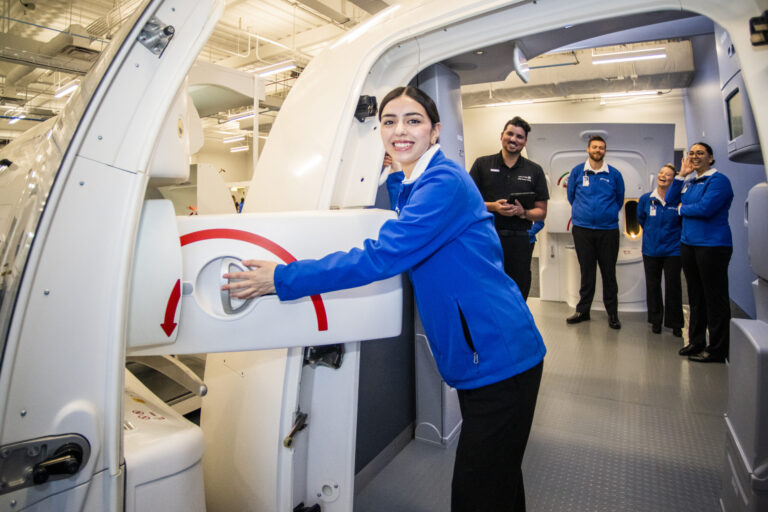
If you clear employment screening, you’ll be invited to Southwest’s four-week Flight Attendant Training class. One of the unique aspects of Southwest’s pre-course learning is that you need to memorize, word for word, the airline’s Public Announcements, along with every destination and airport code Southwest currently serves, and you’ll be tested on both in the first week of class.
New-hire flight attendants can find this process daunting. Southwest gives you access to everything you need four weeks before training starts, and starting on both well before then is worth doing rather than waiting for class to begin.
Training itself is unpaid, but you’ll receive a $1,200 stipend, minus applicable taxes and deductions, within five working days of graduation.
One thing worth being upfront about: four weeks with no income is a real financial gap to plan for, not a technicality. The stipend arrives only after you graduate, not during training, so you’ll want savings or another income source to get through that month.
Pay and Your First Year
Southwest doesn’t pay flight attendants a straightforward hourly wage, but under a Trip For Pay (TFP) system instead. New hires are paid $32.62 per trip after passing training, where a trip is defined as 243 nautical miles, roughly every 55 minutes of flight time.
On reserve, you’re scheduled for a minimum of 78 trips a month. Once you hold a dedicated line, that minimum rises to 80 trips a month, working out to roughly 13 working days a month before accounting for commuting, vacation, or picking up extra flying. Southwest estimates first-year pay at around $38,000 based on those reserve and line minimums, with the opportunity to earn more by picking up additional flying if you want it.
On top of trip pay, you’ll receive an hourly per diem while away from base: $3.04 an hour domestically, rising to $3.63 an hour once international flying is part of the duty period. This is designated specifically to cover meals rather than functioning as extra take-home pay.
Southwest flight attendants are represented by the TWU Local 556 union, which negotiates the pay scale and per-trip rate under a collective bargaining agreement, an important difference from carriers where pay and scheduling are set unilaterally.
A few things worth knowing before you sign: $38,000 is a modest starting income against the cost of living in most of Southwest’s base cities, and pay in year one is built entirely around minimums rather than a fixed salary, so your actual take-home depends heavily on how much flying you pick up. It’s also worth going in clear-eyed about reserve: it comes with far less schedule predictability than a held line, which matters for anyone weighing this against a job with fixed hours.
For the complete breakdown, including the sign-on structure, benefits, and how the package holds up over time, see our full Southwest Airlines Flight Attendant Salary and Benefits guide.
Insight: $38,000 in year one looks different depending on what you’re weighing it against. If you’re also considering Delta, American, Alaska, or JetBlue, our US airline flight attendant salary comparison lines up all five side by side, so you can see where Southwest actually sits rather than judging the figure in isolation.
Base Assignment
Your base is assigned during training, based on Southwest’s operational needs and your seniority within your training class, not on personal preference at this stage. Southwest currently operates 13 crew bases: Atlanta, Austin, Baltimore, Chicago Midway, Dallas, Denver, Houston, Las Vegas, Los Angeles, Nashville, Oakland, Orlando, and Phoenix.
Once you’re established, base transfers are awarded through the seniority system set out in the collective bargaining agreement whenever an opening becomes available, the same principle that governs most of schedule and career life at a US carrier.
How Long Will the Process Take?
Be realistic about timing right now. Southwest’s recruiters can take months to reviews the many thousands of applications they receive evey time a recruitment window opens. As you progress through the application stages, it doesn’t feel like the time lag gets any quicer.
Candidates who have gone through recent hiring events have reported long waits between stages with little communication in between. Applying to become a flight attendant with Southwest is measured in months, and that’s even after the application window has opened.
How to Apply
Applications are only accepted at careers.southwestair.com while a Flight Attendant posting is live. If nothing is currently open, joining the Talent Community is the way to get notified, but remember you’ll still need to submit a full application the moment a window appears, and you’ll want to move fast.
This page is part of our ongoing coverage of Southwest Airlines flight attendant recruitment, covering pay, the application process and what to expect at each stage. If you're getting ready to apply, here's where to go next.