
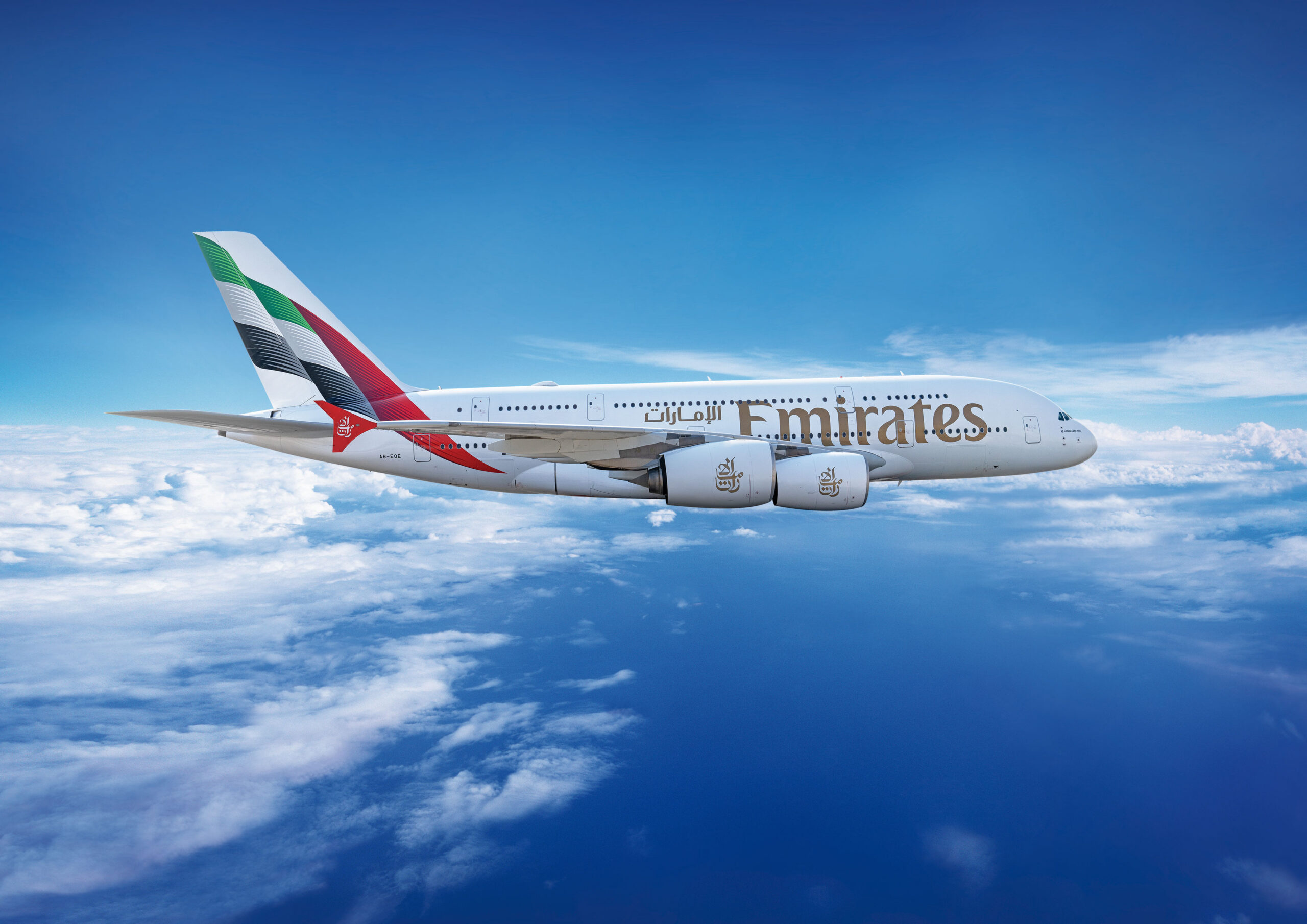

If you are attending an Emirates open day or assessment day, you will be expected to know this airline. Not in the vague, “I’ve always admired Emirates” way that every other candidate will offer, but specifically. Recruiters ask about the fleet, the route network, the cabin products, and the values of the company. Candidates who cannot answer with any depth do not progress.
This cheat sheet gives you everything you need, updated for 2026. Read it, learn the key sections relevant to your stage of the process, and go in prepared.
Key Facts
- Full name: Emirates Airline
- Tagline: Fly Better
- Founded: 25th March 1985
- First flight: 25th October 1985, from Dubai International Airport to Karachi
- Home base: Dubai International Airport (DXB), United Arab Emirates
- Parent company: Emirates Group – a conglomerate of more than 50 brands in the travel and tourism sector. Its other core business is dnata, one of the world’s largest air services providers, covering ground handling, catering, and travel services.
- Ownership: Emirates is owned by the Investment Corporation of Dubai, a sovereign wealth fund controlled by the government of Dubai.
- Chairman and CEO: His Highness Sheikh Ahmed bin Saeed Al Maktoum
- President: Sir Tim Clark, who has held the position since 2003 and was a founding member of the airline in 1985. Two deputy presidents, Adel Al Redha and Adnan Kazim, have been appointed to lead the airline’s future direction.
- Employees: Over 121,000 across the Emirates Group
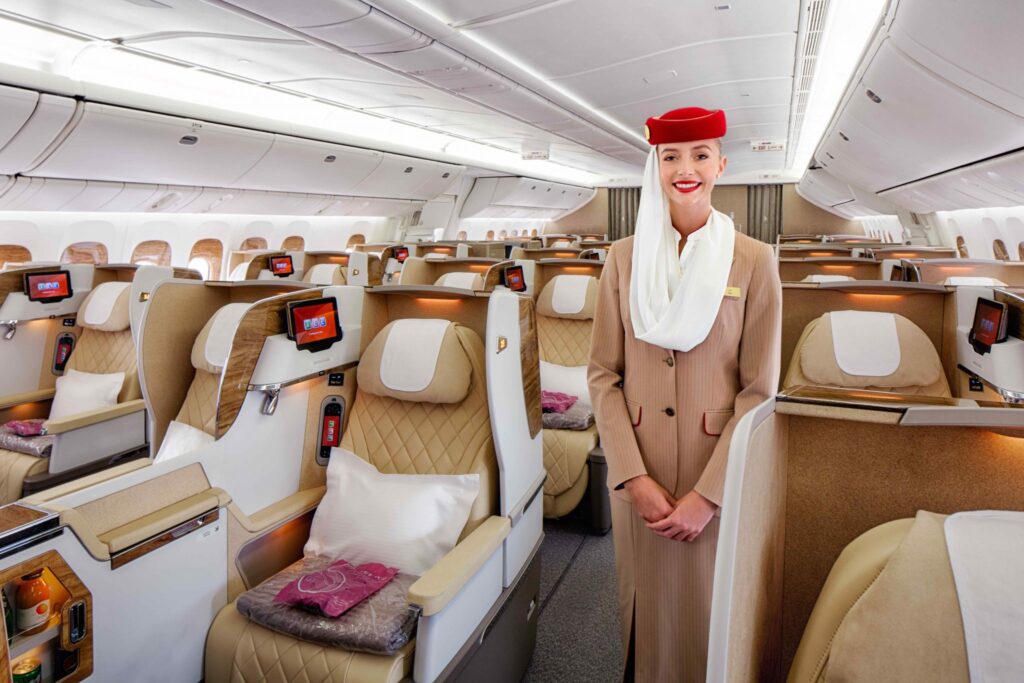
- Cabin crew: A workforce of more than 20,000 hailing from over 150 countries
- Passengers carried: 55.6 million in 2025, operating nearly 180,600 flights
- Revenue: AED 65.6 billion (approximately USD 17.9 billion) in FY2025, a 6% year-on-year increase
- Fleet: 277 aircraft as of March 2026, with an average fleet age of 10.8 years
- Destinations: Approximately 140 destinations across more than 80 countries and six continents
- Tagline: Hello Tomorrow (adopted 2012)
- Alliance: Emirates is not a member of any airline alliance
Worth knowing: The question “what do you know about Emirates?” comes up consistently at open days, either from recruiters informally during CV submission or in the assessment day itself. The candidates who stand out do not recite a Wikipedia summary. Instead, they make a genuine connection between what the airline stands for and why it appeals to them personally. Know the facts, but have your own answer to: what specifically makes Emirates different?
Main Talking Points
These are the themes that define Emirates as an airline. If you are asked what you know about Emirates or why you want to work for them, your answer should draw on at least two or three of these.
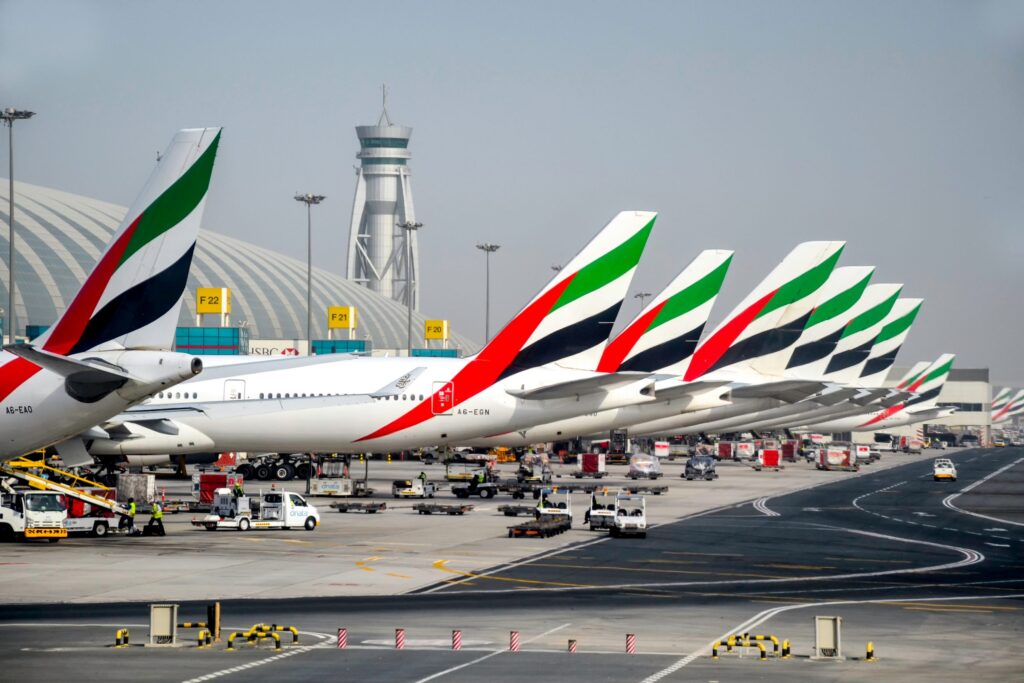
1. Scale and global connectivity: Emirates operates the world’s largest long-haul network from a single hub. Dubai International Airport handled a record 95.2 million passengers in 2025, cementing its position as the world’s busiest airport for international travel. The route network puts roughly two-thirds of the world’s population within an eight-hour flight of Dubai.
2. A genuinely multicultural workforce: Cabin crew at Emirates represent over 150 different nationalities. This cosmopolitan mix of crew shapes the day-to-day working environment in a way that is genuinely distinct from flag carriers whose crews are predominantly from one country. The airline’s base in Dubai adds to this: the city is one of the most internationally diverse in the world.
3. Product leadership and ongoing investment: Emirates has consistently invested in the passenger experience across all cabins. The ICE in-flight entertainment system now offers over 6,500 channels — consistently rated among the best in the world. Premium Economy, a cabin many competitors launched years earlier, is now available on over 100 aircraft serving nearly 70 cities, with capacity set to double to 4 million seats per year by the end of 2026. Starlink satellite Wi-Fi is being rolled out across 232 aircraft, with Emirates set to be the first airline to operate A380s with the technology.
4. A record-breaking new chapter: The 2025-26 financial year delivered the Emirates Group’s highest-ever profit. The airline received 15 new Airbus A350 aircraft during the year, bringing its total to 19 A350s serving 21 destinations. The order book stands at 367 aircraft with deliveries through to 2038 — a statement of long-term confidence in growth.
5. Autism certification and accessible travel: Emirates became the world’s first Autism Certified Airline after training more than 30,000 staff and introducing new digital tools, sensory guides, and dedicated onboard support. This is a meaningful and specific example of the airline’s commitment to service beyond the standard passenger.
History and Heritage
Emirates was founded in March 1985 by Sheikh Mohammed bin Rashid Al Maktoum with a starting capital of USD 10 million and just two wet-leased aircraft from Pakistan Airlines. Five months from concept to first flight.
That first flight, on 25th October 1985, operated as EK800 from Dubai International Airport to Karachi. Within 38 months of launch, Emirates was already serving 12 global destinations. Within 10 years, that number had grown to 34.
In 2003, Emirates struck what was then the largest deal in civil aviation history — an order for 71 aircraft at a list price of USD 19 billion, placed at the Paris Air Show. It was a statement of intent that defined the airline’s next two decades of growth.
Emirates marked its 40th anniversary in October 2025, having grown from two aircraft and a handful of routes to the world’s largest long-haul airline, operating 277 aircraft to approximately 140 destinations across six continents.
Fleet in 2026
Emirates operates an all-widebody fleet. Every aircraft in the fleet is a long-haul capable widebody jet — there are no narrowbody aircraft, no short-haul turboprops, no regional operations.
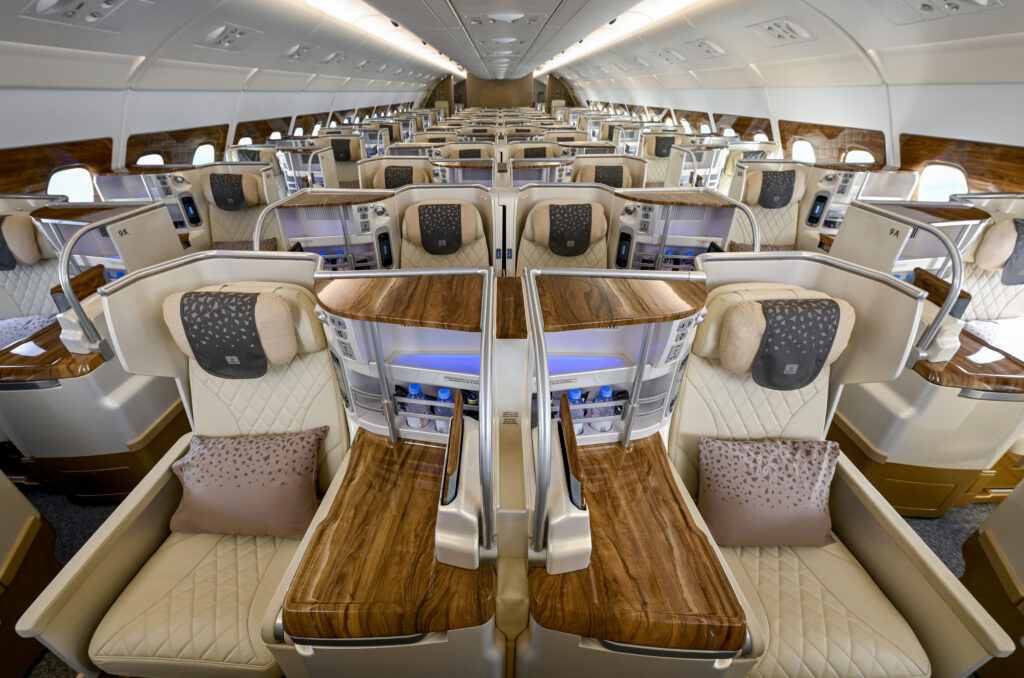
Airbus A380: Emirates operates the largest A380 fleet in the world. The aircraft is a double-decker widebody carrying up to around 500 passengers in Emirates’ standard three-class configuration. The A380 is the aircraft most closely associated with Emirates’ premium product — it carries the onboard First Class shower spa and the Business Class bar and lounge. A major refurbishment programme is underway, with 32 A380s already returned to service with refreshed interiors including the new Premium Economy cabin.
Boeing 777: The workhorse of the Emirates fleet. Emirates operates the largest Boeing 777 fleet in the world. The 777 carries Emirates’ full three or four-class cabin configuration depending on the variant, with refurbishment ongoing across the fleet to bring it in line with the new A380 interiors.
Airbus A350 (new from 2025): Emirates received its first A350 in January 2025 and had 19 in service by the end of the 2025-26 financial year, flying to 21 destinations. The A350 represents the newest generation of Emirates’ product: quieter cabins, improved fuel efficiency, and the airline’s latest interiors, including Business, Premium Economy, and Economy. By 2026, the A350 network will have expanded to destinations including Cape Town, Copenhagen, Phuket, Rome, and Taipei.
Order book: Emirates has 367 aircraft on order with deliveries through to 2038: 270 Boeing 777X, 54 A350s, 35 Boeing 787s, and 8 Boeing 777 freighters. The 777X, the next generation of Boeing’s flagship widebody, has faced delivery delays but remains central to Emirates’ long-term fleet plan.
Cabin Classes
Emirates currently operates four classes of travel across its fleet, though not all aircraft carry all four cabins.
Economy Class: Available on all aircraft. Passengers benefit from a personal ice entertainment screen, complimentary meals and bar service across all flights, and — on newly refurbished aircraft — screens of up to 13.3 inches. Seat pitch is typically 32 to 34 inches on the A380 and 32 inches on the 777.
Premium Economy: Emirates launched Premium Economy relatively recently compared to many long-haul rivals, but the rollout has been substantial. In 2026 it is available on nearly 100 destinations, offered on refurbished A380s, 777s, and all A350 aircraft. Seats offer up to 40 inches of pitch with calf rests and footrests, cream leather upholstery, multi-course dining on china, and the latest ice system. Skywards members can redeem miles to book or upgrade into Premium Economy.
Business Class: Emirates Business Class is one of the most recognisable premium products in long-haul aviation. All seats convert to fully flat beds with direct aisle access on the A380, and the cabin has access to the iconic onboard bar and lounge. On refurbished aircraft, the Business Class product has been updated with new seating and improved interiors.
First Class: Available on selected aircraft. Emirates First Class consists of private suites with sliding doors, a seat converting to a 78-inch flat bed, a personal minibar, and a large entertainment screen. On A380 aircraft, First Class passengers have exclusive access to the onboard shower spa — a fully functioning shower at altitude that remains one of the most distinctive features in commercial aviation. Amenities are provided in partnership with luxury brands.
Emirates Skywards
Skywards is Emirates’ frequent flyer programme, shared with partner airline flydubai. It celebrated its 25th anniversary in 2025 and now has over 37 million members across 190 countries.
Members earn miles based on flight distance, ticket type, and cabin class. Miles can be redeemed on flights, upgrades, and partner rewards. The programme has four tiers:
- Blue: Entry level. Waitlist priority over non-members.
- Silver: Awarded at 25,000 tier miles. Additional baggage, dedicated check-in, lounge access in Dubai, 25% miles bonus.
- Gold: Awarded at 50,000 tier miles. Lounge access at all airports, guaranteed seats on full flights, priority baggage, 50% miles bonus.
- Platinum: Awarded at 150,000 tier miles. 75% miles bonus, complimentary Gold status nomination for a family member or partner.
Worth knowing: As a cabin crew member, your understanding of Skywards matters. You will be talking to frequent flyers every day who want to know how their miles work, what their tier entitles them to, and how to use their rewards. Know the basics.
Emirates and the Community
Emirates runs its own charitable foundation, the Emirates Airline Foundation, which focuses on humanitarian and philanthropic support for children in communities the airline serves across Africa, Asia, and the Middle East. The foundation supports programmes in countries including Ethiopia, South Africa, India, and Bangladesh, including the Emirates Friendship Hospital ship which provides medical care to communities in Bangladesh.
In 2025, Emirates’ Aircrafted KIDS programme distributed more than 3,700 backpacks to children across eight countries, with expansion planned in 2026.
What Recruiters Are Actually Looking For
The point of knowing all of the above is not to recite it. It is to give you the foundation to answer questions naturally and specifically, because candidates who have done the research speak differently to those who have not.
At the open day and assessment day, recruiters are looking for:
- Genuine engagement with the airline: Not enthusiasm for “travelling the world” — engagement with Emirates specifically. What they do, what they are known for, what makes them different from Etihad or Qatar or Singapore Airlines.
- Awareness of the product you will be serving: You will be explaining ice, describing cabin differences, and helping passengers understand their options on every flight. Know the cabins.
- An understanding of who the passengers are: Emirates carries business travellers, leisure travellers, transit passengers connecting through Dubai, and everything in between. The crew role is to serve all of them well, in the same flight.
- Enthusiasm that is grounded, not breathless: The recruiter has heard “Emirates is my dream airline” from dozens of candidates that day. What they have not heard is a candidate who can articulate specifically what they admire about the service standard, the fleet, or the culture — and why that connects to what they would bring to the role.
For a full guide to what happens at the assessment day stage by stage, read: How to Ace the Cabin Crew Assessment Day
For everything you need to prepare your CV and application: Free CV Templates and the CCF Ultimate Recruitment Guide
Find all of your Emirates content on the Emirates category page.