
Southwest Airlines expects flight attendant candidates to have a decent knowledge of the airline, but this is not the time to assume you know everything about this carrier. The airline most people think they know – like open seating, bags fly free, no assigned seating – has spent the last eighteen months rebuilding itself from the ground up. Recruiters are going to expect you to not only know what has changed, but why.
This guide gives you the background and depth to do exactly that, whether you’re preparing for the one-way interview or the in-person day itself.
Key Facts
- Full name: Southwest Airlines Co.
- Founded: March 9, 1967, as Air Southwest, by Herb Kelleher and Rollin King
- Commenced operations: June 18, 1971, flying between Dallas, Houston, and San Antonio
- Headquarters and home base: Dallas Love Field (DAL), Texas
- CEO: Bob Jordan, in the role since February 2022
- Ticker: NYSE: LUV, a nod to Love Field and the airline’s original “love” branding
- Frequent flyer programme: Rapid Rewards
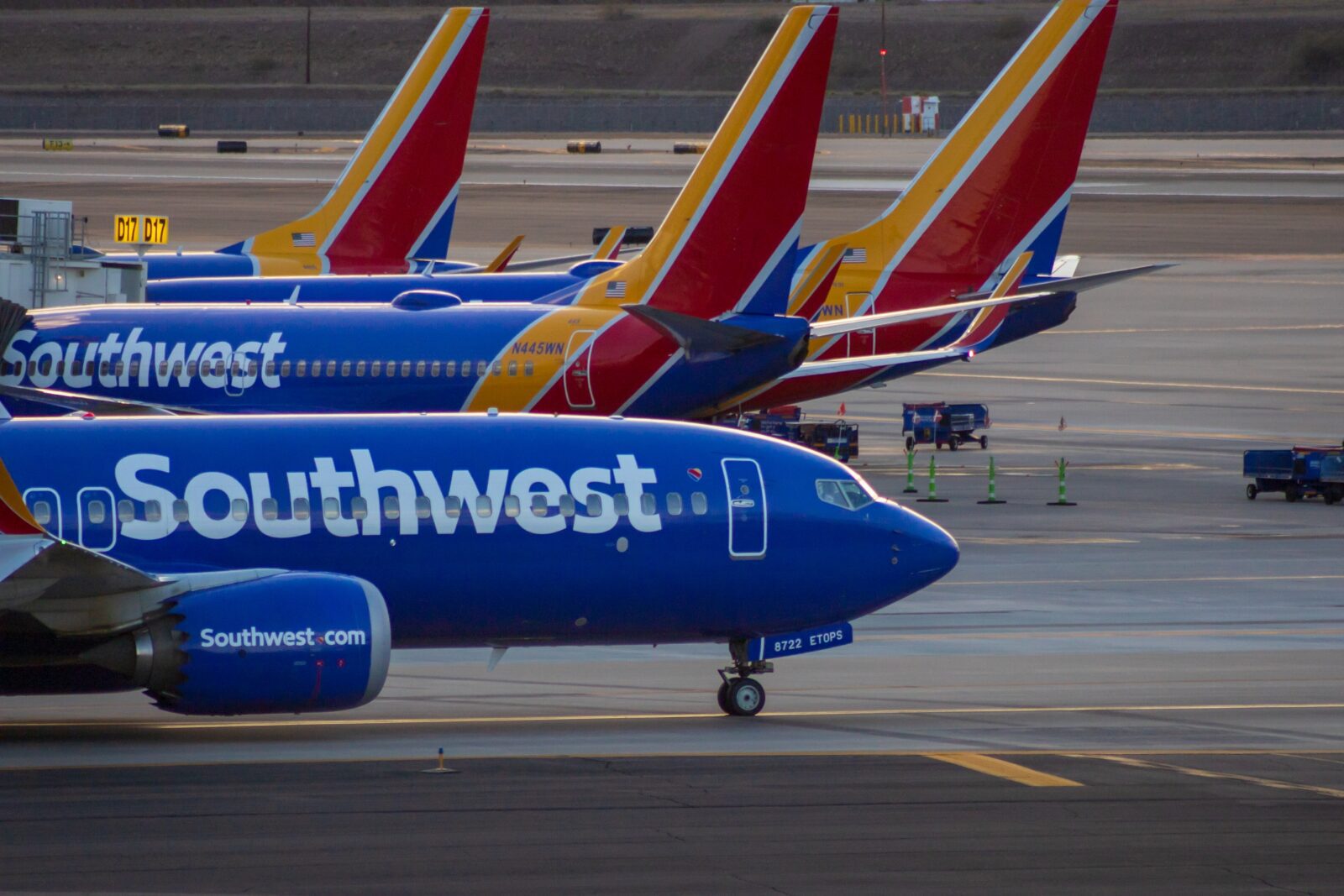
- Fleet size: 803 aircraft in service as of July 2026, all Boeing 737 family: 288 737-700s, 192 737-800s, and 323 737 MAX 8s
- Destinations: Around 115 to 120, spanning the continental US, Hawaii, and a growing international list
- Crew bases: 13, plus a new base under development at Austin-Bergstrom (AUS)
- Employees: Around 73,000
- Full-year 2025 revenue: A record $28.1 billion
- Full-year 2025 net income: $441 million
- Recent recognition: Named The Wall Street Journal’s Best US Airline of 2025, and ranked first in the industry for on-time performance that year
Main Talking Points
1. Southwest 2.0 is the story behind everything happening at the airline right now. After years of pressure from shareholders to modernise a commercial model that had barely changed since the 1970s, Southwest spent 2025 and 2026 rebuilding it from the ground up: assigned seating replaced the open-boarding system on January 27, 2026, extra legroom rows were added to the cabin, a Basic Economy-style fare tier arrived, and checked bag fees were introduced for most fare types for the first time in the airline’s history. Candidates should understand these changes and be able to speak to them without nostalgia for the old model. Recruiters want people who are moving forward with the airline, not defending how things used to be.
2. The transformation is working, on the numbers Southwest cares about most. Full-year 2025 revenue hit a record $28.1 billion, and adjusted earnings guidance for 2026 points to a substantial step up from there. Management has been explicit that assigned seating and the new seat tiers are central to that, with bag fee revenue reported as ahead of expectations too. If you’re asked why Southwest made these changes, that’s the honest answer: they work, and the airline needed them to.
3. The fleet is consolidating around the Boeing 737 MAX. Southwest has always run a single-aircraft-type strategy, keeping training, maintenance, and turnarounds simple, and that principle hasn’t changed even as new airplane models are developed. Southwest is now the largest operator of the 737 MAX 8 in the world; older 737-700s are being retired at pace, and the airline has set a target of an all-MAX fleet by 2031.
4. The network is being reshaped, not just grown. Southwest trimmed close to 30 underperforming routes in its March 2026 schedule, with the steepest cuts at Atlanta, while adding new stations including Knoxville and Santa Rosa domestically, and reaching further afield with new international points including St. Thomas, St. Maarten, Anchorage, and San José in Costa Rica. Red-eye flights, unheard of at Southwest a few years ago, are also expanding fast, with more than 50 scheduled daily by October 2026.
5. A new crew base is coming to Austin-Bergstrom (AUS). It’s a longer-term signal of where Southwest sees growth, adding more than 2,000 pilot and flight attendant roles over time, though in the near term most of that is expected to come from internal transfers rather than new external hiring.
6. Southwest is laying the groundwork for a real shift toward the premium end of the market. In September 2026, Southwest confirmed its first four airport lounges, opening in Austin, Baltimore, Honolulu, and Nashville, co-branded with Chase, with at least seven more planned beyond that. A new premium Chase-Southwest credit card is coming alongside them.
7. Southwest might start flying long-haul, international. Chief executive Bob Jordan has publicly stated the airline is “seriously considering” long-haul international flying for the first time in its history, targeting a small handful of destinations, in the region of eight to twelve, rather than a sprawling widebody network, with Baltimore floated as one possible anchor. Jordan has been clear that nothing is confirmed yet and this sits on a three-to-five year horizon, and it would mean bringing widebody aircraft, likely a 787 or A330, into a fleet that has been all-737 for its entire history. None of this changes day-to-day flying any time soon, but it’s a useful signal of the scale of ambition behind Southwest 2.0, and worth having ready if a recruiter asks where you see the airline heading.
Top Tip: if you’re asked directly what you think of the changes, whether that’s bag fees, assigned seating, or the end of open boarding, frame your answer around choice and better matching fares to what customers actually want, which is Southwest’s own language for it. A candidate who sounds defensive about the old model, or who leads with what’s been lost, reads as someone who’s going to resist change once they’re inside the building too.
History and Heritage
Southwest’s founding story is one every candidate should be able to tell in under a minute. Herb Kelleher and Rollin King founded the airline in 1967 as Air Southwest, with a plan to fly short routes between Dallas, Houston, and San Antonio at fares low enough to compete with driving. Legal challenges from established Texas carriers delayed the launch for four years, and Southwest didn’t get its first flight off the ground until June 18, 1971.
What followed became the low-cost carrier blueprint the rest of the industry eventually copied: point-to-point routing instead of hub-and-spoke, fast turnarounds, and a single aircraft type to keep operations simple. The Wright Amendment, a federal restriction on long-haul flights out of Love Field, shaped Southwest’s route map for decades until its full repeal in 2014, and Love Field itself remains the spiritual home of the airline, hence the LUV ticker on the New York Stock Exchange.
For nearly 50 years, Southwest didn’t record a single annual loss, an almost unheard-of run in commercial aviation, until the pandemic broke that streak in 2020. The recovery since has been real, but it also exposed how much the commercial model needed to change to keep pace with rivals who had already moved into assigned seating and premium products. Southwest 2.0 is the airline’s answer to that.
Insight: Southwest’s influence reaches well beyond the US. In 1990, Ryanair’s Tony Ryan sent a young Michael O’Leary to Dallas to see what Southwest was doing at Love Field. O’Leary watched the airline’s fast turnarounds and single-aircraft-type operation in action, met co-founder Herb Kelleher, and returned to Ireland convinced the model could work in Europe. The result became Ryanair, now Europe’s largest low-cost carrier. It’s a useful line to have ready if you’re asked what makes Southwest significant in the industry, since it shows the model’s influence rather than just reciting Southwest’s own numbers.
Fleet in 2026
Southwest operates an all Boeing 737 family aircraft fleet. As of July 2026, the in-service fleet stood at 803 aircraft, split across three variants:
- Boeing 737-700 (288 in service): The oldest variant still flying, being retired at pace as newer aircraft arrive. Six seats were removed from 737-700s in early 2026 to make room for the new extra legroom rows.
- Boeing 737-800 (192 in service): A larger-capacity workhorse, retrofitted with the new seating options as part of the Southwest 2.0 cabin overhaul.
- Boeing 737 MAX 8 (323 in service): Southwest’s newest and fastest-growing aircraft type, and the airline is now the largest MAX 8 operator anywhere in the world. New deliveries arrive with in-seat power and larger overhead bins as standard, with older aircraft being retrofitted where possible.
On order: 262 Boeing 737 MAX 7s and a further 215 Boeing 737 MAX 8s, plus 140 options. The MAX 7 had not entered Southwest service as of 2026, although a drawn-out certification campaign has now been finalized.
Onboard Product and Seating
Southwest is still, and remains proudly, an all-economy airline. There’s no first class, business class, or premium cabin anywhere in the fleet, and that hasn’t changed. What has changed is how seats within that single cabin are sold and assigned.
Four fare types now shape the booking experience: Basic, Choice, Choice Preferred, and Choice Extra, replacing the older fare lineup entirely for travel from January 27, 2026 onward. Within the cabin, customers now choose between Standard seats, Preferred seats nearer the front, and Extra Legroom seats offering up to five additional inches of pitch on the 737-700.
A-List and A-List Preferred loyalty members get seating benefits built in, from free standard seat selection at booking through to full access to every seat type including Extra Legroom.
Two free checked bags remain in place only for A-List Preferred members and holders of certain co-branded credit cards. For most other fares, the first and second checked bag now carry a fee, a real break from decades of “bags fly free” being the airline’s signature promise.
Onboard Service Culture
Southwest’s onboard product might be changing fast, but the personality behind the service is one of the few things holding steady through all of it, and it’s still distinctive in US aviation. Southwest has never scripted its crew announcements the way most carriers do. Flight attendants are actively encouraged to bring their own humor and personality into safety briefings and PA announcements, and crew who rap, sing, or joke their way through the safety demo aren’t the exception; they’re the culture working as intended.
This personality traces directly back to Southwest’s founding values, and specifically to Fun-LUVing Attitude as a hiring criterion rather than just a nice-to-have. The airline hires for this trait deliberately, on the belief that a crew member who’s actually enjoying the job creates a better experience for customers than one following a script word for word.
Insight: If you’re asked in an interview what appeals to you about Southwest specifically, its onboard culture is a strong, specific answer, provided you can back it up. Naming a real example you’ve seen or heard of, rather than a general “I love how fun Southwest is,” shows you’ve actually paid attention to what makes the airline different.
Frequent Flyer Programme
Southwest’s loyalty programme is Rapid Rewards, and it remains one of the more distinctive in the industry even after the 2026 changes. Points never expire, and there are still no blackout dates on reward seats, both real differentiators from most competitor programmes. Redemption pricing has moved to a variable model in 2026, meaning the number of points needed for a given seat can now shift by demand, similar to how cash fares already work.
Elite status runs through two tiers, A-List and A-List Preferred, both of which now come with seating perks under the new assigned seating system, on top of priority boarding and bonus points benefits that already existed. The Companion Pass, which lets a nominated companion fly free alongside a member for up to two years, remains one of the most talked-about perks in the entire US loyalty landscape.
The co-branded credit card partnership with Chase was renegotiated in 2025 with improved economics and new benefits tied to the updated fare and bag structure, and Southwest has also begun building international redemption partnerships, including an emerging tie-up with Icelandair, a real departure for an airline that has spent its entire history as a purely domestic, point-to-point carrier.
What Recruiters Are Looking For
Southwest’s hiring philosophy is built on a phrase worth knowing before you walk in: attitude over skill. The airline has long said it can teach someone to work a galley or read a boarding pass, but it can’t train someone to actually care about people. Everything in the Assessment Day is built to test for that.
Southwest’s culture runs on three named values, and recruiters are listening for them directly in your answers:
- Warrior Spirit – working hard, striving to be the best, persevering when things get difficult
- Servant’s Heart – following the golden rule, putting others first, delivering what Southwest calls Legendary Customer Service
- Fun-LUVing Attitude – not taking yourself too seriously, being a real part of the team
The most common mistake is reaching for the same value in every answer. Servant’s Heart tends to be the one candidates over-prepare for because it sounds the warmest, which means a well-built example for Warrior Spirit or Fun-LUVing Attitude tends to stand out more, simply because fewer candidates bring one.
Insight: given how central Southwest 2.0 is to the airline right now, don’t be surprised if a recruiter asks something that touches on it directly, how you’d handle a frustrated customer confused by the new seating system, for example. Answer it the way you’d answer any customer service scenario.
For general interview preparation, including how to structure your answers and handle the one-way video interview, our Interview Preparation hub and our full Southwest Airlines Flight Attendant Recruitment Step-by-Step Guide cover the process stage by stage in far more depth than we can fit here.
The Day Itself: What to Remember
The Dallas Assessment Day runs as a full day, combining group and individual elements. A few things specific to Southwest’s version of it:
- Expect an icebreaker exercise, a group exercise, a reach and jumpseat test, and a role play before you move into your individual panel interview.
- The reach and jumpseat check is functional, not a stated number. You’ll need to demonstrate you can reach the overhead bins, fit through the overwing window exit, and sit correctly in a jumpseat harness without an extension.
- Your panel interview is one-on-one, not a group format, so treat every group exercise as being watched just as closely as the interview itself.
- Bring a valid, unexpired passport and any documentation of customer service experience referenced in your application.
Southwest’s Assessment Day windows can move quickly once a hiring round opens, so treat an invitation as something to prepare for immediately rather than something to leave until the week before.
For the full recruitment process, from application through to your first day of training, see our Southwest Airlines Flight Attendant Recruitment Step-by-Step Guide. For general interview technique and presentation, visit our Cabin Crew Interview Preparation hub.
This page is part of our ongoing coverage of Southwest Airlines flight attendant recruitment, covering pay, the application process and what to expect at each stage. If you're getting ready to apply, here's where to go next.