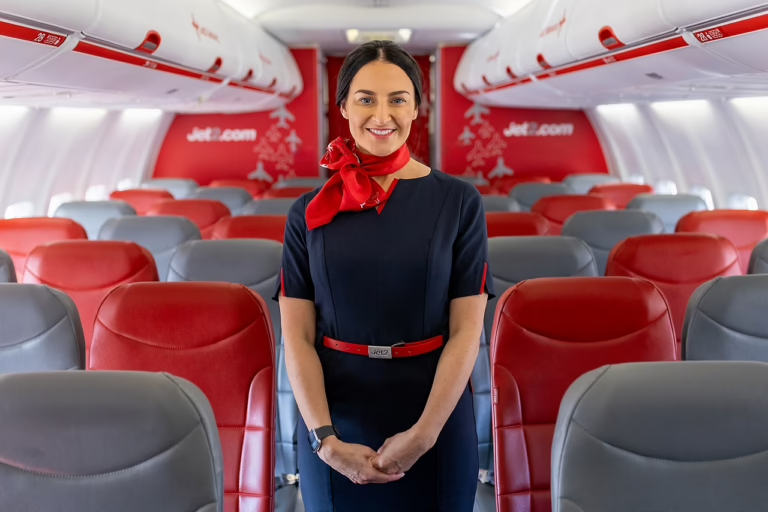


Not every airline directly includes the reading aloud exercise, but it’s worth taking seriously as it not only tests a core cabin crew skill, it can also show up in other ways at your Assessment Day. Sometimes you’ll be given a script individually, often on paper or a tablet, and asked to read it aloud to an assessor, which is a direct simulation of delivering a PA announcement.
Other airlines test the same skill inside a group exercise, asking different candidates to take turns reading instructions aloud to the rest of the group.
What It’s Actually Testing
Here’s a myth worth clearing up first: your accent doesn’t matter. This isn’t about sounding a particular way, as there’s no “correct” accent for cabin crew, and any suggestion otherwise isn’t accurate.
What’s actually being assessed is whether you can read a script aloud clearly, at a sensible pace, while accounting for punctuation. That’s it. It’s a real, practical skill, not a performance, and it’s directly relevant to a job that involves making announcements to a cabin full of passengers who need to understand you the first time, without you repeating yourself.
Top Tip: Don’t get caught in the headspace of thinking your accent ‘isn’t good enough.’ The recruiters are not assessing your accent; they are testing how clearly and confidently you can speak out loud.
How to Read a Script Well
A few specific techniques make a real difference here.
Silently preview the first sentence before you start. Read it in your head a half-second before you say it aloud. This gives you a beat to register where the sentence is actually going, its rhythm, where the emphasis naturally falls, rather than reading blind and stumbling into words you didn’t see coming.
Worth Knowing: Some airlines will give you a minute or two to read through the text and become acquainted with it. Use this time to work out the natural breaks so that you can pace your delivery properly.
Respect full stops properly. A period or full stop is an instruction to pause, not just a symbol at the end of a sentence. Use it as a real breathing point. This does two things at once: it makes you sound more measured and in control, and it gives you the breath support to keep your voice steady through the next sentence.
Slow down, more than feels natural. A PA system strips out some of the lower frequencies in your voice and adds background static, and combined with cabin noise, a normal conversational pace becomes noticeably harder to follow than you’d expect. Reading noticeably slower than you would in person is what actually lands as clear on the other end.
Watch your posture. Standing or sitting with an open chest and straight back gives your voice more room to project clearly and sound crisp, rather than constrained or muffled; the same posture principles that matter throughout the rest of the Assessment Day apply directly here too.
If You Make a Mistake
You will, at some point, stumble over a word or misread a line, and how you handle that moment matters more than the mistake itself.
Treat it exactly like you would in a real conversation: say a brief “sorry,” don’t dwell on it or apologise repeatedly, and pick back up from the point where you made the mistake, not from the beginning. Restarting the whole passage reads as far more rattled than a quick, natural recovery does. Assessors are watching for composure under a small amount of pressure here as much as they’re watching for a flawless read.
The Safety Demo Variant
A common version of this exercise asks candidates to read through, or act out, a safety demonstration, similar in structure to the pre-flight safety briefing you’ve seen on every flight you’ve ever taken. Here’s a practice version to work from.
Practice Safety Demo Script
Your seatbelt fastens by inserting the metal fitting into the buckle, and releases by lifting the buckle cover. Please keep it fastened whenever the seatbelt sign is illuminated.
In the event of a change in cabin pressure, oxygen masks will drop automatically from the panel above you. Pull the mask towards you, place it firmly over your nose and mouth, and breathe normally. Please secure your own mask before assisting others.
Life jackets are located under your seat. In the event of an emergency landing on water, place the jacket over your head, secure the straps around your waist, and inflate it only once you have left the aircraft.
There are six emergency exits on this aircraft, two at the front, two over the wings, and two at the rear. Please take a moment to locate your nearest exit, which may be behind you.
Thank you for your attention, and enjoy your flight.”
Read this aloud a few times, applying the techniques above: preview each sentence, pause properly at every full stop, and slow your pace down more than feels natural. Recording yourself and listening back is one of the fastest ways to notice where you’re rushing without realising it.
Did you notice that the last sentence invites you to say the words in a much more upbeat style than the rest of the text? When you say ‘enjoy your flight,’ smile as you do so, and add some extra enthusiasm.
Where This Shows Up in a Group Setting
Even at airlines that don’t run this as a standalone individual exercise, the same skill often gets tested inside a group exercise instead, one candidate reading the task instructions aloud to the rest of the group before the discussion begins. Volunteering for that role, and doing it well, using exactly the same pacing and clarity techniques, is a real way to demonstrate this skill even if your Assessment Day doesn’t include a dedicated reading exercise.
Insight: This connects directly to the verbal reasoning competency covered in the group exercise itself: reading instructions aloud clearly, so the whole group starts from the same understanding, is one of the specific things recruiters are watching for there.
Your Reading Aloud Checklist
-
Practised reading a script aloud, timing yourself and recording it back if possible
-
Practised silently previewing each sentence a half-beat before saying it aloud
-
Practised pausing properly at every full stop, treating it as a breathing point
-
Slowed your pace down further than feels natural, noticeably slower than normal conversation
-
Practised recovering from a stumble with a brief apology and continuing, rather than restarting
-
Checked your posture, open chest, straight back, for a clearer, more confident voice
This page is part of our Assessment Day Hub, covering everything from the group exercise to what to wear on the day itself. If you're getting ready for your assessment, here's where to go next.