
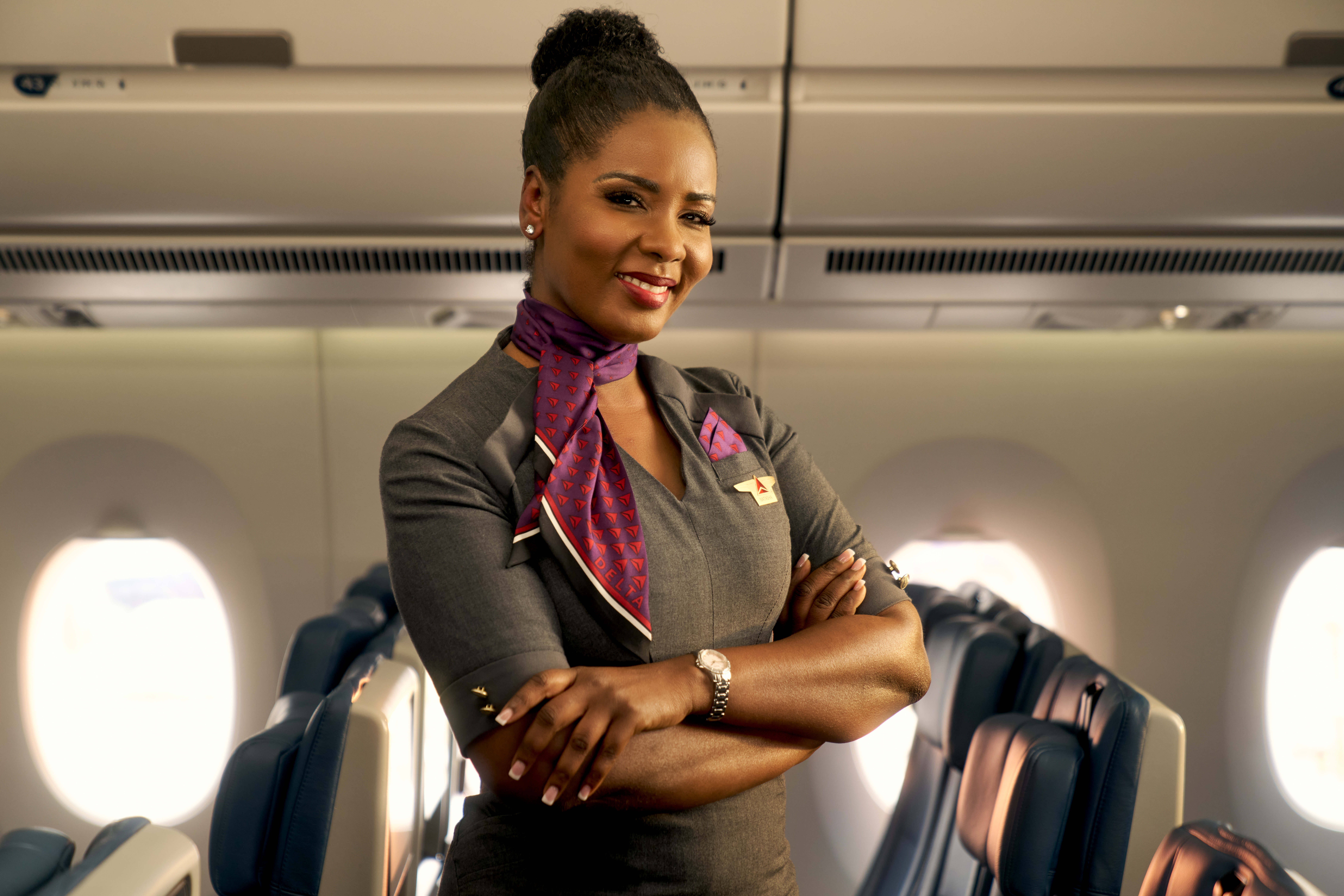

Delta Air Lines publishes one of the most detailed grooming and appearance guides of any US carrier, and it leaves very little to interpretation. Every requirement below comes from Delta’s own official style guide for flight attendants, covering hair, facial hair, nails, jewellery, piercings, eyewear, and watches.
This isn’t Delta being restrictive just for the sake of it. Flight attendants are the most visible representation of the Delta brand, and the airline is precise about what “on brand” looks like, right down to the width of a headband and the size of an earring stud.
Tattoos: What’s Actually Allowed
Delta permits tattoos, but only if they’re not visible while wearing the uniform. According to Delta’s own appearance requirements documentation, a visible tattoo has to be covered, and the airline names two acceptable methods:
- clothing,
- or waterproof make-up.
Bandages are explicitly ruled out as a covering method, and this includes Band-Aids and fabric sleeves.
This standard applies from the interview stage, through Initial Qualification training, and for the length of a flight attendant’s career at Delta, not just at the point of hire.
Worth knowing: The gold standard for covering a tattoo with makeup is alcohol-activated makeup, which requires 99% isopropyl alcohol to activate. Some of the top makeup brands that offer this specialist makeup include Narrative Cosmetics and Skin Illustrator.
Delta’s tattoo policy is very different from the likes of Alaska Airlines, JetBlue, Southwest, and United Airlines, which all allow small tattoos on the arms. For the full airline-by-airline breakdown of tattoo policies, check out our guide: Can Cabin Crew Have Tattoos? What Every Major Airline Actually Says
Hair
Hair needs to be dry, clean, neat, and kept out of the eyes at all times. Only natural-looking color is permitted – no stark contrast highlights or unnatural shades. Bangs need to stay clear of the eyes too, whether they’re worn loose or swept to the side.
Anything touching or longer than the shoulder has to be pulled back and secured in a ponytail, bun, or braid. If it’s up in a ponytail and still extends past the middle of the back, it needs to be pinned rather than left loose. Whatever the style, it can’t extend past shoulder width, and a half-up, half-down style is fine as long as it meets the same requirements. Patterns or designs on any shaved section of the head aren’t permitted.
In terms of hair accessories, one solid black headband is allowed, no wider than half an inch. Scarves, including the uniform scarf, cannot be worn in the hair. Clips, barrettes, bobby pins, hair ties, and scrunchies are fine as long as they’re black, clear, or match the hair colour, and no longer than three inches. Bows and flowers are not permitted.
Worth knowing: A lot of these rules come down to precise measurements rather than general good taste. Day to day, you probably won’t have much of an issue if you’re not fully compliant, but get caught by a manager, and an oversized headband or hair that falls too long, could suddenly become a big problem. If you’re used to more relaxed grooming standards from a previous employer, it’s worth actually measuring rather than eyeballing it before your first day.
Facial Hair (For Male Flight Attendants)
Facial hair needs to be neatly trimmed and well-maintained, with the cheeks and throat kept clean along defined lines rather than left to grow in unshaped. Sideburns can’t extend past the bottom of the earlobe. A beard or soul patch is permitted, but can’t be longer than two inches. Handlebar-style moustaches specifically aren’t allowed.
Nails
Nails need to be clean, neat, trimmed, and chip-free if polished, with all nails the same colour. Length is capped at half an inch past the fingertip. Neon colours, adornments, glitter, chrome finishes, hand-painted designs, and airbrushed nails are all off the table, but a French manicure or French tip is fine as long as the rest of the requirements are met.
Jewellery
- Bracelets: Up to two, including a fitness tracker or medical ID. Charms or anything hanging from a bracelet aren’t permitted.
- Earrings: Up to two per ear, in gold, silver, white pearl, or clear diamond or diamond-like studs, no larger than a dime. No hoops, no double-sided earrings, no ear-stretching gauges or spacers, and earrings can’t be connected to each other by a bar or chain.
- Necklaces: Only one necklace is allowed, no longer than 18 inches or thicker than a quarter inch, with at most one charm or pendant, no larger than an inch across.
- Rings: Up to three, with a maximum of two per hand. A wedding ring set counts as a single ring. Non-wedding rings can’t have a face larger than a dime.
Facial Piercings
A single side-nose piercing is permitted, with a pinhead stud in gold, silver, white pearl, or clear diamond-like material. No other visible facial or body piercings are allowed.
Eyewear and Contact Lenses
Glasses can’t carry adornments, diamonds, rhinestones, beads, glitter, or studs, and can only be suspended by a thin black, gold, or silver cord or chain if worn that way. Sunglasses are for outdoor wear only. They are never to be worn indoors or when talking to a customer. Contact lenses need to be a natural eye colour.
Watches
Delta permits watches in black, brown, silver, rose-gold, gold, or white, including smartwatches, as long as the watch face and band don’t promote an organisation, charity, or cause.