
American Airlines runs a seven-stage recruitment process, built to run over a long timeline. Candidates selected in the current hiring round won’t start training until 2027, so this is a process to plan for patiently rather than expect to move through in a matter of weeks.
This guide walks through every stage of the American Airlines flight attendant recruitment process, plus the preparation and honest context that actually helps you pass each one, the kind of detail an airline’s own careers page can’t give you, since that would mean telling candidates exactly how to beat their own selection process.
Is American Airlines Currently Recruiting?
After several delays, American Airlines opened its latest flight attendant hiring window on October 5. For this hiring round, American Airlines has rebuilt its recruitment process. Every stage of this new process is explained in detail below.
Status verified: October 5, 2026What You Need to Know Before You Start
A few things about American’s process are worth understanding before you apply:
- Training doesn’t start until 2027. If you’re applying for the upcoming hiring round, be realistic about the gap between application and your actual start date as this is a long runway, not a fast-moving process.
- The first two years are straight Reserve. Under the current 2024 contract, new hires serve two full years of straight Reserve after training before qualifying for any line-holding rotation at all, followed by three further years on a one-month-on, one-month-off Reserve rotation. That’s a five-year runway before you have a realistic prospect of consistently holding your own schedule.
- Training is six and a half weeks in Dallas-Fort Worth. Your base isn’t assigned until week 3 of training, and once you graduate, you’re required to report to it within 5 days.
- Probation runs 6 months from your start date. During this time, American Airlines can terminate your employment at any time, and you have very few rights to fight your corner.
Worth knowing: A five-year path to consistent line-holding is a significant commitment to weigh up before you apply. It doesn’t mean the job isn’t worth it, but it’s worth factoring in that your schedule is going to be all over the place for at least half a decade before you start getting proper control over the flights you work.
Minimum Requirements
- Age: Minimum age: 21
- Education: A high school diploma or equivalent
- Languages: Fluent English; additional languages are an asset, and bilingual roles may involve a separate language assessment
- Citizenship: US citizenship or legal authorization to work in the US, and the ability to travel unrestricted in and out of every country American operates to
- Height: No fixed minimum height, but candidates must pass a functional reach test to access overhead emergency equipment, and a jump seat fit/harness test
- Physical fitness: Ability to swim and tread water
- Previous experience: Customer service experience is generally described as preferred rather than mandatory
- Background checks: Pass a background check and drug screening
Insight: Rather unhelpfully, American Airlines’ current height rules state that the minimum height requires candidates to be able to reach and remove emergency equipment from overhead bins without assistance. And the maximum height requires candidates to have adequate head clearance in the cabin.
American is explicit that no prior Flight Attendant experience is required, and that it recruits on customer service instinct, communication, composure, and genuine warmth, the kind that makes passengers feel looked after rather than processed.
The Recruitment Process, Step by Step
Step 1: Watch the “Before You Board” Video
Before you even submit an application, American has you watch a short preview video describing the hiring process and giving an honest look at the role. Treat this as more than a formality; it’s a genuine opportunity to self-select honestly before you invest the time in a long process.
This is an attempt by American Airlines to get candidates to really think about whether the carrier is the one for them. Can you really handle two years of straight reserve, with no set schedule, on-call for up to 24 hours at a time, and called out with just two and a half hours’ notice?
Ultimately, American Airlines is looking for people to build a long-term career, but to do so requires real sacrifices for at least five years.
Step 2: Apply and Complete the Online Assessment
Submit your application with your qualifications and experience, then complete an online assessment measuring your strengths and capabilities.
For the online assessment, answer honestly rather than trying to guess the “right” answer; values-fit assessments are generally designed to catch inconsistency, and a mismatch between your assessment answers and your later interview responses is a red flag recruiters are trained to notice.
Our Cabin Crew Situational Judgment Practice Test is a useful way to get a feel for this kind of assessment before you sit the real one.
Step 3: Personal Introduction Video
If you’re selected to continue, you’ll record a short, self-recorded video responding to situational questions, with 72 hours to complete it – what is commonly referred to as an On-Demand Video Interview or ODVI.
ODVIs test how you think, communicate, and demonstrate care for others, not just what you say. Practice answering out loud before you record, and treat your first answer as a draft rather than assuming you have to nail it in one take. Once invited to complete your ODVI, you’ll have just 72 hours to complete the assessment.
If you haven’t done an on-demand video interview before, our two-part guide walks through exactly what an ODVI is and how to actually ace one. Given the short amount of time you have to complete this assessment, it’s worth reading before these guides sooner rather than later.
Step 4: Virtual Interview
Candidates who progress past the PDVI stage will be invited to take part in a live virtual conversation with a member of American’s recruiting team.
This stage is new for the 2026 hiring cycle. Treat it as a full interview in its own right, not a preliminary chat before the “real” in-person stage. American is using the virtual interview as an additional filter before committing to the cost of flying candidates to Dallas, so it carries real weight.
Prepare specific, real examples in advance rather than generic statements; a recruiter having a live conversation with you will notice the difference between a rehearsed answer and a genuine one immediately.
Our SOAR to Success framework is worth learning before this stage; it’ll help you structure competency-style answers clearly under live conversation pressure, rather than rambling or freezing when a follow-up question comes.
Step 5: In-Person Group Experience
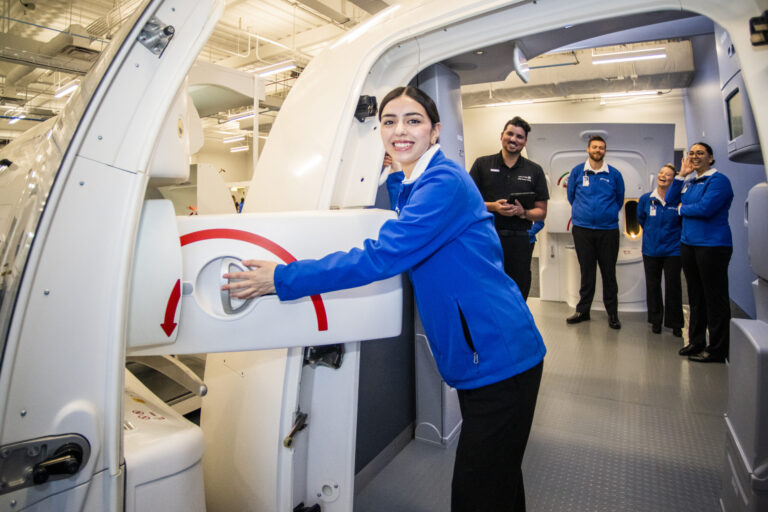
Candidates who advance past the live virtual interview will be invited to attend an in-person group experience in Dallas where you will meet members of American’s team and take part in interactive activities designed to let you demonstrate safety, service, and care in action rather than just talk about them.
This is the stage where group dynamics matter most: recruiters are watching how you behave when you’re not the one currently speaking, not just your own individual contributions. Our Cabin Crew Assessment Day Hub pulls together everything we’ve written on performing well in exactly this kind of in-person group setting.
There’s lot of guides within the hub, so we recommend doing your research and working through the hub sooner rather than later.
Step 6: Initial Flight Attendant Training
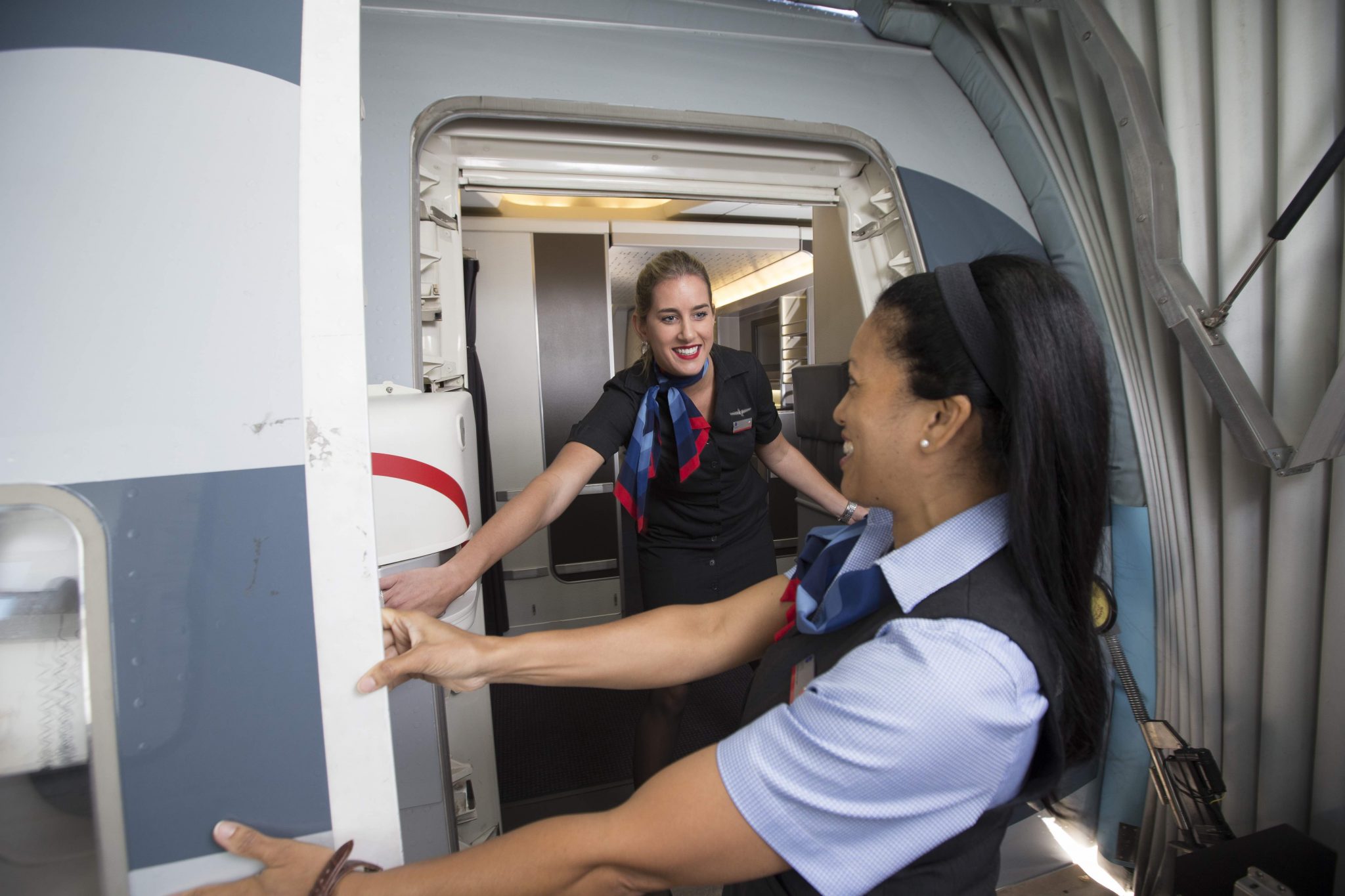
Successful candidates attend six and a half weeks of training at American’s dedicated training facility in Dallas Forth Worth. During this time, you are being continuously assessed, and anyone who doesn’t meet the carrier’s rigorous standards will be released from training.
Forget what you know or think about flight attendant appearance and grooming standards. During training its important that you fully comply with the rules set by the training college. Even small mistakes or wilful rule violations are noticed and could end up in disciplinary action.
Candidates who don’t live in the Dallas area will be flown to Texas at the expense of American Airlines, and will be provided their own hotel room for the duration of the training course. Meals are also provided, but a regular salary isn’t, so this expense needs to be factored in.
Step 7: Earn Your Wings
Successfully completing training is what officially begins your career as an American Airlines Flight Attendant. At this point, you’ll start a six-month probationary period. Your ability to arrive at work on time is crucial during this period. American Airlines will be closely monitoring your attendance and punctuality, and even a small slip-up could result in you being let go.
Worth Knowing: During the six-month probationary period, the flight attendant union (APFA) does not have the power to fight your corner. If you are let go during this time, it is at American’s sole discretion.
Training
Training runs six and a half weeks at the Robert L. Crandall Campus in Dallas-Fort Worth. Your base is assigned during week 3 of training, not at the start and not at graduation, so you’ll spend the first couple of weeks not yet knowing where you’ll end up living.
Classes for the current hiring cycle are expected to begin in the first or second quarter of 2027, generally concluding by May or June.
If you don’t live in the Dallas-Fort Worth area, American provides confirmed flights to and from training, not just to the in-person interview stage. Hotel accommodation is covered for the full training period, with transport arranged between the hotel and the training center, and you’ll have your own room rather than sharing.
Initial training itself is unpaid, though single-occupancy housing and three meals a day are provided throughout, a real cost taken care of even without a paycheck during this stretch.
After graduation, you’re required to report to your assigned base within 5 days, so it’s worth planning your move in advance rather than waiting to find out your base before you start thinking about logistics.
American’s initial uniform allocation isn’t provided free; the cost is deducted from your pay in increments of no more than $25 per paycheck, a real early-career expense worth budgeting for rather than being surprised by, once you’re actually earning a paycheck to deduct it from.
Applications are submitted on the American Airlines recruitment page here.
This page is part of our ongoing coverage of American Airlines flight attendant recruitment, covering pay, the application process and what to expect at each stage. If you're getting ready to apply, here's where to go next.