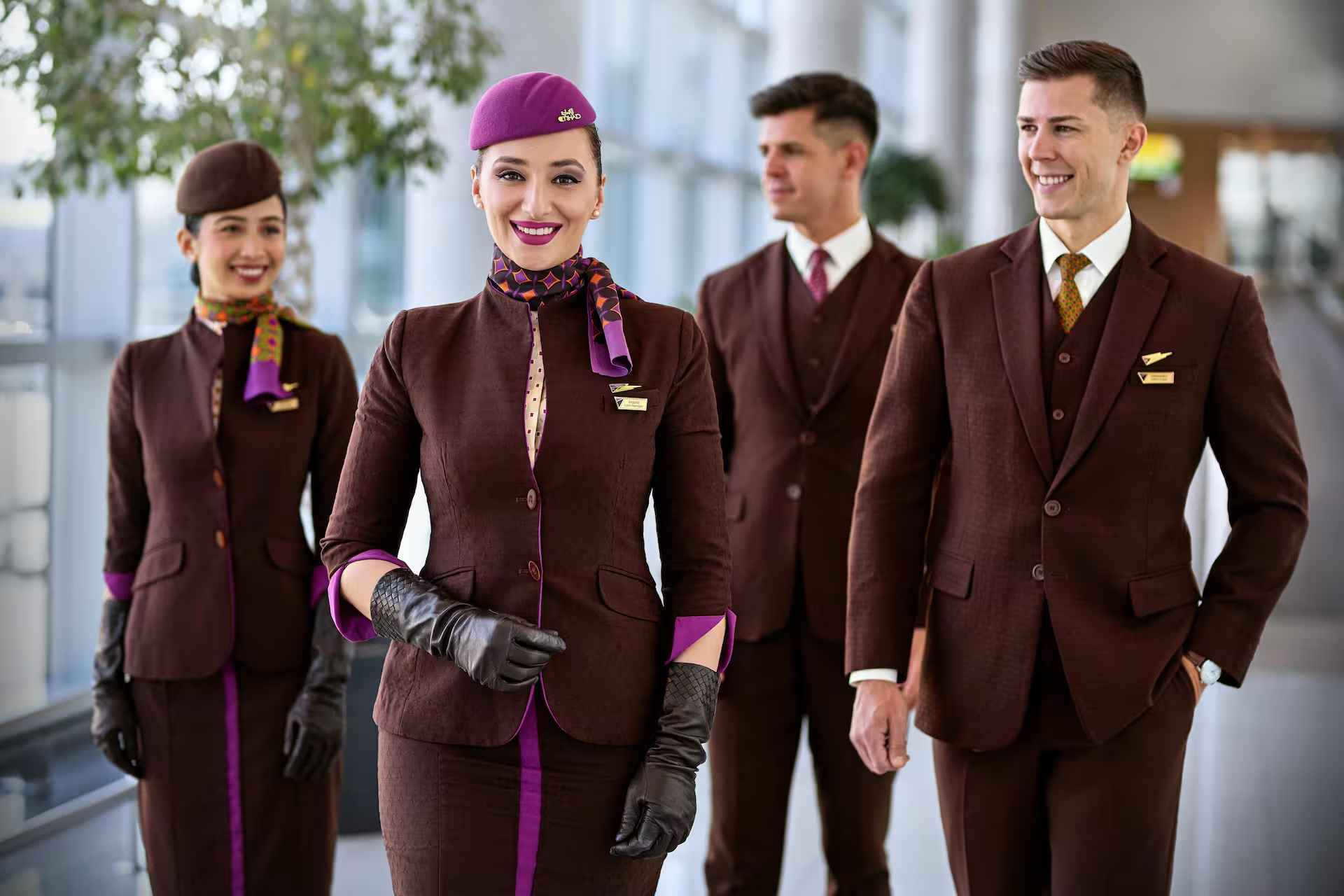

Every airline has a grooming and conduct guide, but Etihad’s is unusually specific, and buried in among the expected rules on hair and uniforms are a handful that genuinely surprise people. Some are about what you can read on board. Some are about the exact colour of a plaster. One is about the width of a winter scarf, in centimetres.
This isn’t a criticism; most of these rules exist for real, sensible reasons once you understand the context. But they’re also the kind of detail that makes for a much better assessment day answer than “I’ve read the careers page,” so here’s what most candidates don’t know going in.
You Can Only Read Company-Approved Material
Reading on board is restricted to Etihad’s own printed guides, manuals, and magazines, the kind you’d find in the seat pocket or the aircraft’s literature folder. It’s not phrased as a suggestion… It’s the standard. Bringing your own novel or personal magazine to read during a quiet moment isn’t part of the picture, the way it might be in another job or even another airline.
You Must Be Seated to Eat, and There’s a Whole Etiquette Around Drinks
Eating or drinking in uniform is only permitted while seated; standing with a snack in hand isn’t compliant. Hot drinks add their own layer of nuance: a takeaway coffee cup can be carried by hand, but crew aren’t permitted to actually drink from it while walking, the cup is for carrying, not sipping on the move. Drinking straight from a bottle or soda can isn’t permitted at all.
Chewing Gum Is Banned Outright
No exceptions, no context given, chewing gum simply isn’t permitted while in uniform. It’s a small rule, but one that trips up candidates who don’t think to mention it as a habit worth dropping before day one.
Headphones Are Banned in Uniform, Even Off the Clock
Crew can’t wear headphones or earphones while walking around in uniform, and this isn’t limited to the airport. It covers walking to and from the crew base, hotels, and even just outside your own accommodation, anywhere you’re still visibly in uniform. The one specific exception is the crew lounge at where headsets are actually required rather than banned.
Your Phone Is Only for Emergencies, and Even Then You Have to Be Discreet
Personal phone use while in uniform is restricted to genuine emergencies, and the standard doesn’t stop there: even in an emergency situation, such as walking between the car park and the terminal, crew are still expected to keep phone use discreet rather than open and visible. It’s a rule that assumes an emergency doesn’t excuse being seen on your phone in uniform, only that it justifies having it out at all.
Senior Crew Check Your Apple Watch Is Charged
Smartwatches are permitted on duty, but there’s a genuine operational reason behind that flexibility: watches are used to synchronise timing during onboard medical situations and emergencies. Because of that, it’s not left to the individual crew member alone; senior cabin crew are responsible for confirming that your Apple Watch has enough charge before the flight, and a spare analogue or digital watch has to be carried in case the battery runs out mid-duty, regardless.
Henna Isn’t Permitted at All
Given Etihad is a Gulf carrier based in a region where henna carries genuine cultural significance, its total ban while in uniform is one of the more surprising specifics in the whole guide, stricter than the position some other Gulf carriers take on the same question.
Insight: This is a good reminder that regional culture and airline brand standards don’t automatically align, even at a carrier headquartered in the same region where a practice is culturally significant. It’s worth checking an airline’s actual grooming policy rather than assuming local customs will be reflected in it.
Braces Are Banned, With One Very Specific Exception
Dental jewellery of any kind is out, and most braces are too. Only Invisalign or similar clear aligners are permitted, and even then, you first have to obtain an exemption letter from the image and uniform department. The one further exception on top of that: white sapphire braces, which can be approved on a genuine case-by-case medical necessity basis. It’s about as narrow an exception as a grooming guide gets.
The Hair “Doughnut” Has a Maximum Size
Several of Etihad’s approved bun styles use what the guide calls a hair doughnut, a padded accessory used to shape the bun. It has to be fully concealed, match the wearer’s hair colour, and cannot exceed 6cm in diameter. It’s oddly precise for what is, at the end of the day, a small foam ring.
Transition Lenses Aren’t Allowed
Photochromic lenses, the kind that darken automatically in sunlight, aren’t permitted while in uniform. It’s an easy detail to miss if you already wear this type of prescription lens day to day and don’t think of it as a style choice rather than a medical necessity.
Cold Sores and Styes Have to Be Reported
A cold sore or a stye isn’t just something to manage quietly, it needs to be reported to the Image and Uniform team. If it develops while downroute while away from base, the crew member is expected to work in a position that keeps them out of passenger presence entirely, rather than carrying on as normal until they’re back home.
Even Plasters Have a Colour Code
Band aids aren’t permitted on the face or neck at all while in uniform; if one is genuinely needed, crew are told to contact the Style & Image team directly rather than just applying one. Anywhere else on the body, only transparent or skin-toned plasters are accepted. A coloured or patterned plaster isn’t considered part of a compliant look.
Personal Hygiene Gets Its Own Section
Before the guide even reaches hair or makeup, it covers the basics: showering or bathing before every duty, wearing a light perfume or deodorant, and starting each shift in clean socks, hosiery, and undergarments. It’s not unusual guidance in itself, but it’s unusual for an airline’s official style document to spell it out this explicitly rather than assuming it goes without saying.
This page is part of our extensive coverage of Etihad's cabin crew recruitment process, which is drawn from years of following the airline's open days and assessment process. If you're getting ready to apply, check out these essential links.