

Psychometric and personality testing is now a standard part of cabin crew recruitment, although this is far from an aviation-only trend, as a large majority of Fortune 500 companies now use some form of psychometric testing somewhere in their hiring process. One of the biggest suppliers of these tests is Aon Assessment Solutions (still widely known by its former name, cut-e), which many airlines use for their personality tests.
These tests are usually part of an early screening stage, well before you get anywhere near a human recruiter.
Why Airlines Use Personality Tests
Recruiters aren’t just looking for candidates who can technically do the job; they’re looking for people whose personality, attitude, and ethos fit the airline’s culture, and who’ll consistently deliver strong customer service.
A personality test attempts to measure this objectively, using short statements about your feelings and reactions to different situations, then comparing your profile against the traits an airline has predefined for the role. According to Aon’s own leadership, the appeal for employers is straightforward: a well-built questionnaire can measure the specific competencies, abilities, and motivational traits a role needs, in a way that’s more consistent and scalable than judgment calls alone.
Insight: These tests don’t just filter people out. Recruiters often use the results to flag specific areas worth probing further, such as temperament under pressure, or attitude to risk, and raise them directly with you at a later stage. If you make it through to a final interview, don’t be surprised if a question feels like it’s circling back to something you answered on the personality test days or weeks earlier.
Which Airlines Use Them
The cut-e (Aon) Shapes test is one of the most widely used formats in the industry, adopted by airlines including Lufthansa, Scoot, Finnair, EasyJet, Aer Lingus, Etihad, flydubai, and Norwegian. Emirates uses a broadly similar test of its own.
Shapes was built specifically to help recruiters match candidates against the competencies a role requires, drawing on established workplace psychology research and years of consultancy work across sectors, rather than being adapted from a generic, off-the-shelf personality framework.
How This Differs From a Values-Fit Assessment
A cut-e-style personality test measures broad workplace traits such as teamwork, resilience, attitude to change, and so on, against a general profile of what makes a strong hire in the role.
This is different from a values-fit assessment, which is narrower and more specific. Rather than measuring general personality traits, it scores you against an airline’s own named, published values. If you’re applying to Delta, Alaska, United Airlines, or British Airways, this is more likely to be the format you’ll face rather than a general cut-e test. Our own Values Fit Practice Assessment is built around the confirmed frameworks these airlines actually use, worth trying instead of (or alongside) the preparation below if that’s the test ahead of you.
How They Work
Most cabin crew personality tests take 15 to 20 minutes on a computer, tablet, or smartphone. They’re not built like traditional assessments such as the Predictive Index or Myers-Briggs. Technically, there’s no single right or wrong answer, and you’re shown a series of statements and asked how well each one describes you.
These tests are designed to capture your ingrained personality rather than a learnable competency, which is exactly why trying to crudely “game” them doesn’t tend to work.
In the Cut-e test, you will be presented with several statements that you have to award points to based on how much you agree with them. You are given a maximum of six points for all three statements and have to share them amongst the statements.
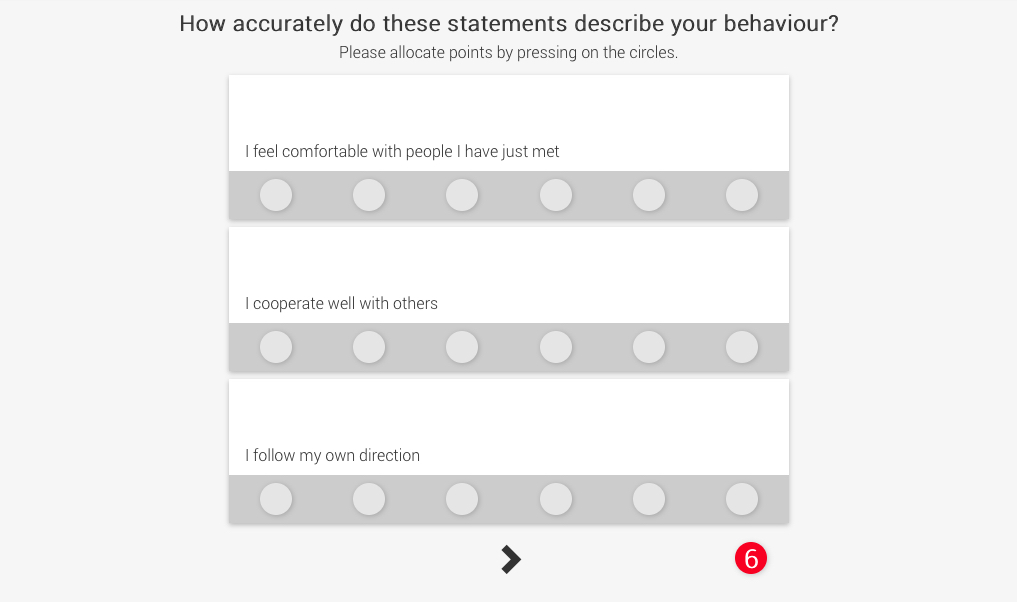
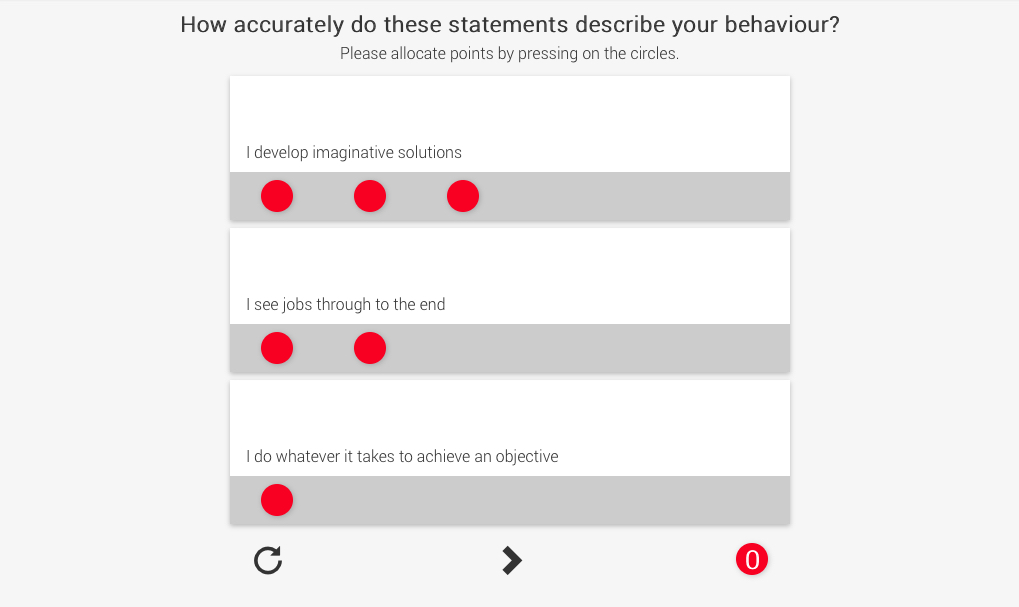
Worth knowing: Many cut-e style tests use a forced-choice format rather than a simple agree/disagree scale. You’re given a small number of points (often six) to distribute across two or three statements on the same screen, rather than rating each one independently. That forces a genuine trade-off rather than letting you rate everything highly, so it’s worth reading all the statements on a page before allocating anything, rather than scoring the first one and working down.
Can You Prepare for It?
It’s a fair question: if the whole point is to be yourself, how do you prepare? The useful reframe here, echoed by testing researchers, is that a personality test is really just one snapshot of you, and like a job interview, you can think in advance about how you want to present yourself without that being misleading.
Preparing well means understanding what’s actually being measured and reflecting on your own real strengths, not memorising a supposed answer key. Here’s what that looks like in practice.
What the Categories Actually Measure
Questions are typically grouped into categories, including:
- Teamwork
- Personal responsibility
- Attitude to change
- Motivations
- Personality at work
- Resilience
- Analytical thinking
- Creative thinking
Take teamwork as an example. You might be asked to rate your agreement with statements like:
- I enjoy working in teams
- My best work is done when I’m alone
- I like working in the company of others
- I enjoy working towards a common goal
- Individual targets are important to me
Top tip: Notice that several of these statements are really asking the same underlying question, whether you’re a team player or prefer working alone. They’ll reappear in different forms throughout the test, and answering consistently across them matters more than how you answer any single one.
Cabin crew is a team-dependent role, so reflecting on real examples of enjoying collaborative work will generally serve you better than dwelling on times you preferred working solo, but the point is accurate self-reflection, not reverse-engineering a target score.
Recognise Control Questions, and Answer Truthfully
Most personality tests are built assuming some candidates will try to present an idealised version of themselves, and design control questions specifically to catch it. These tests assume people will shade their answers, and treat that shading itself as a signal worth detecting.
Take a statement like “I would never lie to a colleague, no matter what the circumstances.” Nearly everyone has, at some point, told a small lie for a reasonable reason. Answering with maximum agreement here doesn’t read as virtuous, but as implausible, and implausible answers are exactly what control questions are built to catch.
There’s a big difference between emphasising your actual strengths and flatly denying normal human behaviour. Aim for the former.
Read Carefully and Manage Your Time
Some tests use fairly complex language deliberately, since testing the same underlying trait in slightly different phrasing is part of how the test checks for consistency. Read each statement carefully and think about which trait it’s actually getting at before answering.
There’s usually no strict time limit, but airlines typically expect the test to take around 15 to 20 minutes, and most platforms will give you a practice question before you start. Use it. Read the instructions properly, and don’t feel you need to answer instantly. Try not to overthink every statement, as a small number of inconsistent answers is normal and accounted for. Answering every single question identically is more likely to look artificial than a few natural variations.
How to Practise
If you’ve never encountered a test like this before, a free practice personality test can help you get comfortable with the format, even if it won’t be identical to the one you’ll actually face. The 16Personalities test is a reasonable free starting point, though it’s worth knowing its format (categorising you into a personality “type”) is quite different from the statement-rating, points-allocation style most cabin crew tests use, so treat it as a warm-up for thinking about yourself clearly, not a direct simulation.
Your Personality Test Checklist
-
Got a proper night’s sleep before sitting the test, tiredness and stress noticeably affect your answers
-
Confirmed whether you’re facing a general personality test (cut-e/Shapes) or an airline-specific values-fit assessment, and prepared for the right one
-
Understood what each category (Teamwork, Resilience, Attitude to Change, etc.) is actually trying to measure
-
Practised answering consistently, since the same trait is tested multiple ways throughout
-
Avoided extreme, “too perfect” answers on statements, a control question is likely testing
-
Read every statement carefully, rather than rushing, while staying roughly within the airline’s suggested time
This page is part of our Online Assessments Hub, covering everything from video interviews to situational judgement tests and personality assessments. If you're preparing for the next stage, here's where to go next.