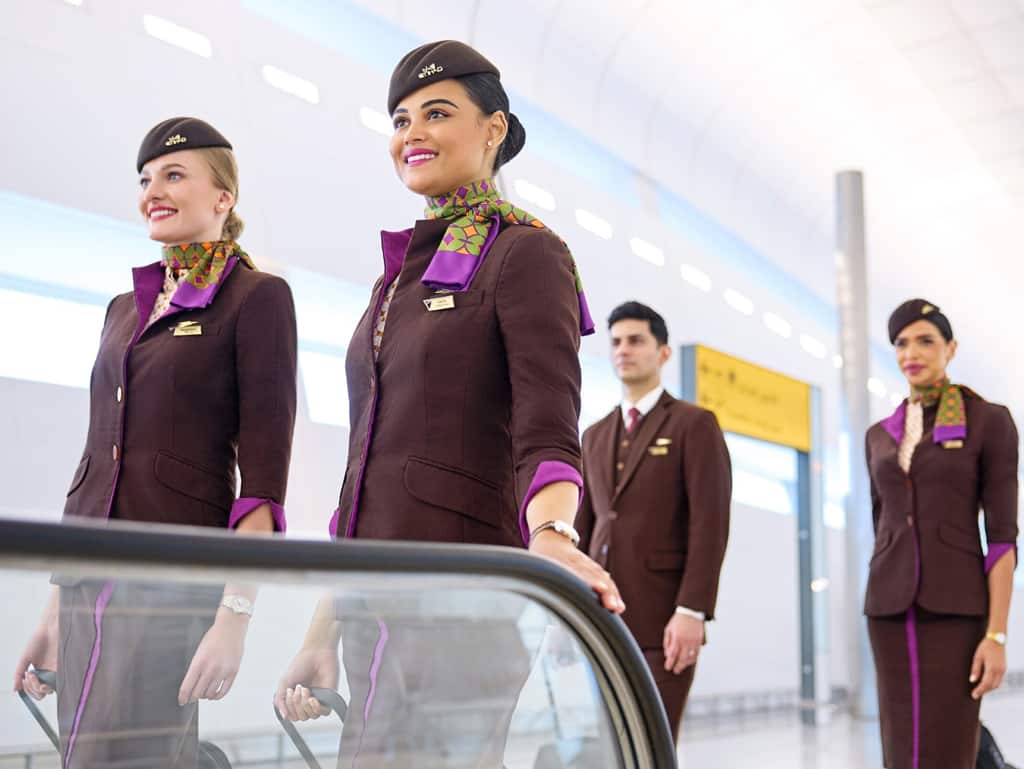

Etihad Airways offers one of the more competitive cabin crew packages among Gulf carriers — tax-free pay, free accommodation in Abu Dhabi, and a travel benefit that extends to family members on an unlimited basis. The package is not quite as generous as Emirates on the headline figures, but Abu Dhabi is a considerably cheaper city to live in than Dubai, and Etihad is widely regarded by serving and former crew as the most relaxed and supportive of the big three Middle East carriers. You will still work hard — the standards are high, and the rosters are demanding — but the atmosphere is more collegiate, the crew base is smaller and more tight-knit, and people generally report a better day-to-day experience than at the larger Gulf operations.
There is also a timing factor worth flagging. Etihad is midway through its most aggressive expansion in years, targeting 38 million passengers annually by 2030 under its Journey 2030 strategy. A larger network means more flying hours, more layovers, and more of the variable pay that makes the monthly total meaningful. Joining Etihad now means you are joining a growing airline with faster promotion opportunities available.
This guide breaks down exactly what Etihad cabin crew earn in 2026, what the benefits are worth in practice, and what to factor in before you sign.
If you are considering applying, the full recruitment process guide is here: Etihad Airways Cabin Crew Recruitment 2026: The Complete Step-by-Step Guide
The Contract
Etihad cabin crew are employed directly by the airline on a fixed-term contract, typically two to three years, renewable at the end of the term. You are not employed through an agency. The probationary period is six months, during which basic pay is slightly lower.
During ab-initio training — which lasts approximately six weeks — crew receive a training allowance of approximately AED 2,500 (USD 680) per month. This is designed to cover essentials during the training period. Full salary begins once you are flying on the line.
Insight: Etihad’s direct employment model means you have proper employment rights, access to the airline’s medical insurance and benefits from day one, and a structured career progression path. This distinguishes it from carriers or routes where crew are engaged through intermediary agencies. Etihad also has a strong internal promotion record — 31% of cabin crew were promoted within their first 12 months as of the airline’s most recent reporting.
Etihad Airways Cabin Crew Salary
Like all Gulf carriers, Etihad’s pay is made up of three components: a fixed basic salary, flying pay calculated on block hours, and layover allowances. The UAE imposes no personal income tax, so everything you earn is yours to keep, subject to your home country’s tax rules on overseas income.
All figures are in UAE Dirhams (AED) with USD equivalents in brackets. The AED is pegged to the USD at 3.67.
- Basic monthly salary: Approximately AED 3,500 to AED 4,000 (USD 953 to USD 1,089) for new joiners, rising after the probationary period. During ab-initio training, a reduced allowance of AED 2,500 (USD 680) applies.
- Flying pay: Approximately AED 50 to AED 60 (USD 14 to USD 16) per block hour, depending on aircraft type and seniority. The clock runs from pushback to gate arrival. With an average of 70 to 90 flying hours per month, flying pay adds approximately AED 3,500 to AED 5,400 (USD 953 to USD 1,471) to the monthly total.
- Layover allowance (per diem): Paid for every night spent away from Abu Dhabi base. Rates vary by destination. European and North American destinations pay at the higher end — approximately AED 384 (USD 105) per day in cities like London, Madrid, or Chicago. Regional destinations pay at the lower end, approximately AED 240 to AED 336 (USD 65 to USD 91) per day. What you do not spend, you keep.
All-in monthly estimate, year one: A new joiner on a typical mixed long-haul and regional roster can expect total monthly earnings of approximately AED 10,000 to AED 12,000 (USD 2,723 to USD 3,268). Crew flying predominantly long-haul routes with regular overnight layovers in high-allowance cities can push toward AED 13,000 to AED 14,000 (USD 3,540 to USD 3,812) per month. Senior crew and pursers can earn upward of AED 18,000 to AED 20,000 (USD 4,904 to USD 5,449) per month.
In GBP for UK applicants: the AED 10,000 to AED 12,000 monthly range converts to approximately £2,200 to £2,650 per month at current exchange rates.
What Does This Look Like in Your Currency?
Based on typical first-year monthly earnings of approximately AED 10,000 to AED 12,000 for a new Etihad crew member on a mixed roster:
| Currency | Monthly Estimate |
|---|---|
| 🇺🇸 US Dollars (USD) | $2,723 to $3,268 |
| 🇬🇧 British Pounds (GBP) | £2,140 to £2,565 |
| 🇪🇺 Euros (EUR) | €2,510 to €3,010 |
| 🇦🇺 Australian Dollars (AUD) | AU$4,150 to AU$4,985 |
| 🇨🇦 Canadian Dollars (CAD) | CA$3,730 to CA$4,475 |
| 🇮🇳 Indian Rupees (INR) | ₹226,000 to ₹271,000 |
| 🇵🇭 Philippine Peso (PHP) | ₱152,000 to ₱183,000 |
Converted at approximate rates as of June 2026. Etihad pay is tax-free in the UAE. Depending on your home country’s tax rules, you may have reporting obligations on overseas income. Currency rates change — verify current rates before making any financial decisions. Senior and long-haul crew earn significantly more. (USD 2,723 to USD 3,268). Crew flying predominantly long-haul routes with regular overnight layovers in high-allowance cities can push toward AED 13,000 to AED 14,000 (USD 3,540 to USD 3,812) per month. Senior crew and pursers can earn upward of AED 18,000 to AED 20,000 (USD 4,904 to USD 5,449) per month.
Worth being upfront about: the basic salary at Etihad is modest by itself. The package only makes financial sense when the full picture — flying pay, layover allowances, free accommodation, and tax-free status — is taken into account. Month-to-month earnings are variable, and new joiners with less control over their roster will experience that variability most acutely. Budget around the base figure for fixed costs and treat the variables as what they are.
Worth knowing: Etihad vs Emirates on salary is a common question. Emirates basic pay is slightly higher (AED 4,980 vs AED 3,500 to AED 4,000 for Etihad), but Abu Dhabi is a cheaper city to live in than Dubai, particularly for dining, transport, and leisure outside the company accommodation. Many crew find the net financial position is closer than the headline figures suggest, and consistently describe the Etihad working environment as more personal and less pressured than the larger Emirates operation.
Accommodation and Transport
All Etihad cabin crew are based in Abu Dhabi and provided with fully furnished shared accommodation. The accommodation includes gym facilities and utilities. Crew share apartments, typically with one to two other people.
Transport to and from the airport and training centre is provided free of charge via shuttle bus 24 hours a day.
Married crew or those in qualifying relationships may opt for an independent-living allowance instead of company accommodation. The allowance covers a contribution toward private rental costs in Abu Dhabi, though the exact figure should be confirmed during the recruitment process as it is subject to periodic review.
For overnight international layovers, Etihad provides hotel accommodation. Crew do not pay for layover hotels. The quality of layover hotels is generally well-regarded, particularly on long-haul routes.
End of Service Benefit
In line with Gulf employment norms, Etihad pays an end-of-service gratuity at the conclusion of your contract rather than contributing to a pension scheme. The gratuity is calculated based on basic salary and length of service, and increases significantly the longer you remain with the airline.
This is not a pension — there is no fund compounding over time. For candidates from UK or European backgrounds where employer pension contributions are standard, factor this into your financial planning before joining. The tax-free salary provides stronger capacity to save independently, but that requires the discipline to actually do so.
Etihad Airways Cabin Crew Benefits
- Accommodation: Fully furnished shared apartment in Abu Dhabi with gym facilities included. Utilities covered by Etihad. Crew do not pay rent.
- Transport: Free shuttle bus between accommodation, the airport, and training centres, running 24 hours a day.
- Staff travel: Unlimited standby tickets for crew, parents, spouse, and children on the Etihad network. Economy confirmed annual leave ticket to your home country. Business and First Class tickets for crew, spouse, children, and parents, subject to availability.
- Medical insurance: Worldwide medical and insurance coverage, fully paid by Etihad throughout employment.
- Uniform: Provided by the airline and maintained by Etihad.
- Training: All initial training paid. Ab-initio training lasts approximately six weeks. Ongoing recurrent safety training is part of your working schedule.
- iSave Card: Etihad’s employee discount programme covering affiliated restaurants, hotels, retail, and leisure activities across Abu Dhabi and the wider UAE.
- Career progression: Structured and transparent promotion path. Etihad has committed to recognising and rewarding performance, with 31% of crew promoted within their first year.
Worth knowing: Monthly pay is variable and directly linked to flying hours and layover patterns. The basic salary alone does not constitute a livable income for Abu Dhabi without the other components. The end-of-service benefit replaces a pension rather than supplementing one. And while UAE income is tax-free, your home country may still require you to report overseas earnings — check your personal tax position before you rely on the full figure being net pay.
How Does Etihad Compare?
Etihad sits between Emirates and Qatar Airways on the overall package. Emirates pays a higher basic salary and operates a larger, more mature network with more consistent flying hours. Qatar offers a comparable pay structure, but Doha has stricter rules around personal conduct and living arrangements, though conditions have improved under recent management.
Where Etihad genuinely stands apart is the working environment. It is consistently described by serving and former crew as the most relaxed and supportive of the big three Middle East carriers. The crew base is smaller — more like a community than a workforce — and the management culture has been more people-focused than its neighbours for a number of years now.
That does not mean it is easy. You will work hard, rosters are demanding, and the standards are high. But candidates who have worked at more than one Gulf carrier consistently flag Etihad as the place where they felt most supported day to day. For candidates weighing up the big three, that is a meaningful differentiator that does not show up in the salary figures.
Compare Etihad Airways cabin crew salary and benefits against Emirates, Qatar Airways and flydubai →
Ready to Apply?
If the package works for you, the full recruitment process guide covers every stage from online application to training: