


Not all airlines are created equal. Let’s be honest – Etihad Airways is a very different airline to say, Delta Air Lines or Ryanair. That’s not to say that one airline is better than the other – Ryanair is Europe’s largest airline so they’re clearly doing something right. But it doesn’t quite spark thoughts of glamour and luxury like Etihad.
Why am I talking about this? Because when it comes to landing your dream job as a member of Cabin Crew you really need to understand what the airline recruiter is looking for. The biggest part of this preparation is to prove that you have the skills, qualities and competencies that make an excellent flight attendant.
But that’s not the only thing that Cabin Crew recruiters are looking for. They also want to know whether you will fit in with the culture of their company. Do you have the same values as the airline? Does your ethos match that of the company? Is your personality, work ethic, style and attitude going to fit in with everyone else who works for the company?
These are really important questions to ask (and address) even before you submit your application or turn up at a Cabin Crew Open Day. If you’re to have the best chance of achieving your dream you need to understand what makes the recruiters and the airline tick.
Here’s how it works: A lot of recruiters and airline hiring managers have worked with the same airline for years. They are deeply embedded within the company culture. They’ve grown up with the airline and know exactly what type of person they want to hire – the people they know match the culture of their airline.
They do this by making conscious (and sometimes unconscious) judgements about your personality. How you dress, the way you present yourself and most importantly – the words you choose. And the first opportunity you have to get this right is on your Cabin Crew resume.
The trick is to appeal to the Cabin Crew recruiter by showing that you understand the company culture, what their priorities are and what makes them different to other airlines. By doing this you’ll demonstrate that you can fit right in and will be a valuable asset to their airline.
So here’s how to tailor your Cabin Crew resume to appeal to the recruiter. We’ll use Emirates as an example:
1. Research, research, research
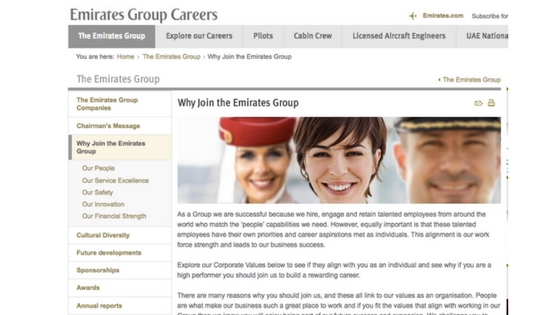
Scour the careers website for your chosen airline. Nearly every company has an ‘about’ us section which will give you clues about their priorities and company culture. This is a section written by recruiters and hiring managers so it can be a real eye opener into their world.
Pay attention to the airline’s social media channels. What style do they write in? What does the airline focus on when selling itself to customers? Check Instagram, YouTube, Facebook and Pinterest. Twitter can sometimes be useful but most airlines use the platform for short customer service interactions that have a limited use.
You might think you know everything you need to know about the airline but this exercise can be really enlightening.
2. Create a list of keywords
Write down keywords that you pick up from these sources. Group them into categories that match the qualities and competencies that airlines are looking for in their Cabin Crew. For example:
Teamwork = Multi-cultural, cosmopolitan, etc.
Customer Service = A genuine passion for helping others.
Resilience = Confidence, flexibility, maturity.
The keywords above are just a start. You’ll find a lot more keywords during your research. Before long you’ll notice trends about what the airline focuses on the most.
For a full list of the qualities and competencies, you need to highlight in your Cabin Crew have a look at this article: The Best Qualities to Highlight in Your Cabin Crew Application Resume
3. Use the keywords carefully
Warning: If used inappropriately keywords can actually ruin your resume. I’ve written before, about the risk of simply stuffing your resume with keywords.
However, used in the right way, you can blend these keywords into your real-world examples. Don’t feel the need to use every single keyword you’ve found.
This process will take a little time to get right. You might have to rethink how you’re going to write your evidence so that the keyword makes sense in the context of your example. It’s important to point out that this isn’t about cramming your resume with buzzwords.
You’re going to carefully pick a few keywords that you can work into your examples. If it doesn’t work with the evidence you have, it doesn’t work. Don’t force it. The idea is to sound natural and a good fit for the company – You don’t want to come across like you’re trying too hard.
4. Make it part of your vocabulary
Getting the chosen keywords in your resume is just the start. Just like the rest of us, airline recruiters are drawn to people who speak in the way they do – it’s human nature.
Really become acquainted with the keywords you’ve learnt. Live the company culture in your everyday life.
Before long, you’ll use the same words as the recruiter in a natural and effortless fashion. You’ll have the same passion for the airline as the recruiter does. Everything you say will focus on what the airline see’s as its priorities.
Think this sounds crazy? I was sceptical at first as well. The truth is, however, that this really does work.