
If you are attending a British Airways cabin crew assessment day, you will be expected to know this airline. Not in a vague way, but able to recite facts that demonstrate a genuine interest in the airline. Recruiters test knowledge of the fleet, the cabin products, the British Airways Club, and what BA stands for as a brand. Candidates who cannot answer with breadth and depth do not progress.
This cheat sheet covers everything you need, updated for 2026. Learn the sections relevant to your stage of the process and go in prepared.
Key Facts
- Full name: British Airways
- Founded: 1974 in its current form, though the airline traces its history to 25th August 1919 — the world’s first daily international scheduled air service, between London and Paris
- Home base: London Heathrow Airport (LHR), Terminal 5
- Other bases: London Gatwick (Euroflyer and Long-Haul), London City Airport (CityFlyer)
- Callsign: Speedbird
- Motto: To Fly. To Serve.
- Parent company: International Airlines Group (IAG), formed in 2011 when British Airways merged with Iberia. IAG also owns Vueling, Aer Lingus, and Iberia Express. The CEO of IAG is Luis Gallego.
- CEO: Sean Doyle — appointed in 2020, leading a £7 billion transformation programme described as one of the most ambitious investment commitments in BA’s history
- Employees: Approximately 40,000, including around 15,000 cabin crew
- Passengers: 46.7 million customers flown in 2025 across 183 destinations
- Operating profit: £2,230 million in 2025 — up £182 million on 2024
- Punctuality: 82% of flights departed within 15 minutes in 2025, the best performance since 2011
- Alliance: oneworld — a founding member alongside American Airlines, Cathay Pacific, and Qantas
- Frequent flyer programme: The British Airways Club
- Loyalty currency: Avios — shared with Iberia, Aer Lingus, Finnair, and Qatar Airways
Main Talking Points
These are the themes that define British Airways. If you are asked why you want to work for the airline or what you know about it, draw on at least two of these.
1. A century of aviation heritage: BA’s history stretches back to the birth of commercial aviation in 1919. That heritage is part of what the brand means — the Speedbird callsign, the “To Fly. To Serve.” motto, the sense that this airline has been part of Britain’s story for over 100 years. Knowing this and being able to connect it to why you want to represent the brand matters.
2. A genuinely good employer by industry standards: BA has direct employment, union representation through Unite and GMB, structured career progression, and a pension scheme. In an industry where agency contracts and variable terms are common, this is worth understanding and being able to speak to. The contract is actually decent — a fact the voice and authority behind this site is willing to say directly.
3. A transformation in progress: Sean Doyle’s £7 billion transformation is the most significant investment programme in BA’s modern history. It covers fleet renewal, cabin refurbishment, digital upgrades, and sustainability commitments. New lounges in Miami and Dubai opened in 2025; Heathrow lounges are next. Free, ultra-fast Starlink Wi-Fi has started to roll out since March 2026. A new First seat is launching this year.
4. The oneworld advantage: BA is a founding member of oneworld airline alliance which comprises 15 global airlines, serving over 1,000 destinations globally. For passengers, this means seamless connections and reciprocal benefits across American Airlines, Cathay Pacific, Qantas, Finnair, Japan Airlines, and more.
5. A diverse network from multiple bases: Heathrow handles the majority of BA’s long-haul network — North America, Asia, Australia, Africa, alongside an expanding short-haul network. Gatwick Euroflyer covers European short-haul. London City handles premium short-haul through CityFlyer. Each base offers a different flying experience. Knowing which base you are applying to and why it suits you is a genuine differentiator in the assessment process.
Insight: When BA recruiters ask why you want to work for British Airways specifically, the honest and effective answer connects to something specific about the airline rather than generic enthusiasm. The heritage, the transformation programme, the union protections, the oneworld network, the base that suits your life — any of these is a credible and specific answer. “I’ve always loved British Airways” is not.
History and Heritage
The forerunner of British Airways operated the world’s first daily international scheduled air service on 25th August 1919 — London to Paris. Imperial Airways followed in 1924, opening routes to Africa, the Middle East, and India. BOAC and BEA merged in 1974 to form what is now British Airways.
In 1976, BA introduced commercial supersonic travel with Concorde — an iconic moment in aviation history, even if the aircraft has long since been retired. The airline was privatised in 1987 and became a founding member of the oneworld alliance in 1999. Terminal 5 at Heathrow — BA’s dedicated home — opened in 2008.
In 2011, BA merged with Iberia to form the International Airlines Group, bringing together two historic European flag carriers under one parent company.
Fleet in 2026
British Airways operates a mixed fleet of widebody long-haul aircraft and narrowbody short-haul jets. The 747 — once the most iconic aircraft in the BA fleet — was retired in 2020. The fleet today is considerably more modern.
Long-haul fleet:
- Boeing 787-8, 787-9, and 787-10 Dreamliner: The backbone of the current long-haul fleet. Fuel-efficient, modern cabin environment, used on routes across North America, Asia, Africa, and South America.
- Boeing 777-200 and 777-300: The widebody workhorse on high-demand long-haul routes. The 777-200 fleet is due to be replaced from 2029 onwards by new Boeing 787-10s, along with the Boeing 777X.
- Airbus A380: 12 in the fleet, operating to high-demand destinations including Los Angeles, San Francisco, Boston, Hong Kong, and Singapore.
On order: 32 Boeing 787-10s, first deliveries to Gatwick from 2029. 62 new widebody aircraft in total due to join the fleet by the mid-2030s.
Short-haul fleet:
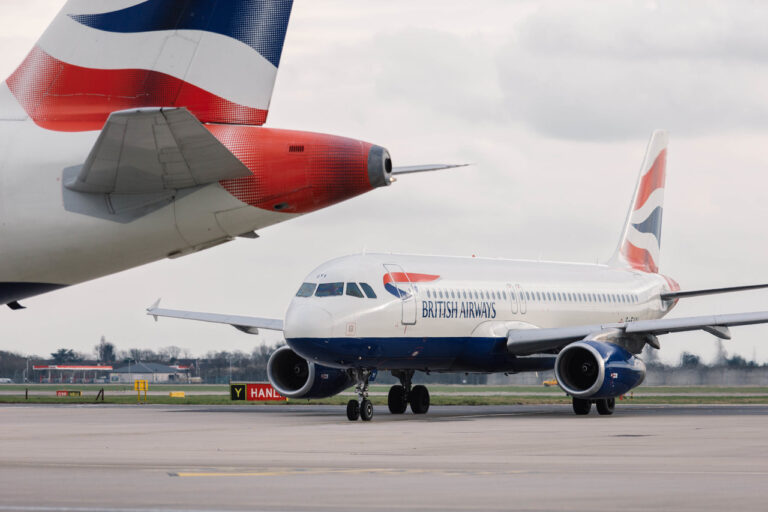
- Airbus A319, A320, A321: The core European and domestic fleet operating from Heathrow, Gatwick, and regional airports.
Worth knowing: The Boeing 747 — “The Queen of the Skies” — was retired from the BA fleet in July 2020, earlier than planned, as a result of the pandemic. For candidates who grew up watching the 747 as the symbol of British Airways, it is worth knowing that it is no longer in service.
Cabin Classes
Euro Traveller (Economy, short-haul) The main cabin on European and domestic flights with Buy On Board catering complimented with a free bottle of water and snack for all passengers.
Club Europe (Business Class, short-haul) The front cabin on European and domestic routes. Complimentary food and drink service, lounge access at Heathrow and Gatwick, and priority boarding. The seats are the same as Economy, but the middle seat is left empty to create more space.
World Traveller (Economy, long-haul) The main cabin on all long-haul flights. Complimentary meals and drinks, audio/video entertainment on demand, and standard seat pitch. Wi-Fi available, rolling out free via Starlink from March 2026.
World Traveller Plus (Premium Economy, long-haul) Available on most long-haul routes. Wider seats with increased pitch, recline, and footrest, enhanced meal service in a dedicated, smaller cabin. Customers in this cabin expect a premium service and it’s up to the cabin crew to differentiate the experience from standard Economy.
Club World (Business Class, long-haul) BA’s long-haul business class product. British Airways has nearly completed the rollout of its Club Suite product with full-aisle access from every seat, privacy doors, and more storage than the old ying-yang Business Class seats. Catering is provided by Do&Co, representing a significant investment for British Airways. Amenity kits are supplied by the White Company.
First Available on selected long-haul routes. A private suite with a seat converting to a fully flat bed, luxury turndown service, and amenity kits filled with Elemis products. A new First seat product is launching in 2026 as part of the transformation programme, that will debut on the A380 superjumbo.
The British Airways Club
The British Airways Club is BA’s frequent flyer programme, first launched in 1985. The loyalty currency is Avios — shared across oneworld partner programmes, including Iberia Plus, AerClub, Finnair Plus, and Qatar Airways Privilege Club. Members can transfer Avios freely between all five programmes.
There are four main membership tiers:
- Blue: Entry level. Access to Avios earning on BA and partner flights.
- Bronze: Priority check-in, 20% bonus Avios collection, advance seat selection.
- Silver: Lounge access, priority boarding, 50% bonus Avios, extra baggage allowance.
- Gold: First Class check-in and boarding, access to BA First lounges, 100% bonus Avios, maximum extra baggage.
Worth knowing: The British Airways Club also has two additional tiers – Gold Guest List and Premier.
Gold Guest List is an enhanced level of the Gold tier, but not actively advertised by BA. Premier is an invite-only tier that is only offered to BA’s most important customers – the type of customers that make business travel decisions for an entire corporation.
As cabin crew, you will interact with British Airways Club members on every flight. Know the tier colours, understand what each level entitles passengers to, and be aware that Avios earned on a BA flight can be spent on a Qatar Airways booking, and vice versa.
Charity and Community
BA’s long-running charity partnership is with Comic Relief through the Flying Start programme. More than £14 million has been raised over the years to support children in challenging circumstances around the world. BA crew are among the programme’s most active fundraisers.
The BA Better World Community Fund raised £10 million in 2025, supporting 367 charities — one of the strongest corporate community commitments in the UK aviation sector.
What Recruiters Are Looking For
The same principle applies as with any cheat sheet: the goal is not to recite facts. It is to be able to speak about British Airways with genuine knowledge and specific engagement.
At the BA assessment day, recruiters are assessing warmth, composure, communication, and teamwork — but underpinning everything is whether you actually understand the airline you are applying to represent. Candidates who have read the press releases speak differently to those who have not.
Know the transformation programme. Know the Club Suite rollout. Know the Avios currency and what it means across the oneworld network. Know why the base you are applying to suits you specifically. And have your own genuine answer to why British Airways, and why now.
The reality is that BA is a better airline to work for than its reputation sometimes suggests — union protections, direct employment, and a career that can genuinely develop. If that resonates with you, say so.
For everything you need on the recruitment process: British Airways Cabin Crew Recruitment 2026: The Complete Step-by-Step Guide
For CV preparation: Free CV Templates and the CCF Ultimate Recruitment Guide
All British Airways content on CCF: BA Category Page