
Where you’re based as a United Airlines flight attendant will shape almost everything about the job, including your commute, the kind of flying you do, how long you will spend on Reserve, and what your actual quality of life looks like day to day. This guide covers how base assignment and bidding actually work, a base-by-base breakdown using real bid package data, and the honest reality of seniority at a carrier this size.
We’ve obtained United’s own primary lineholder position counts as of August 2026 to give you a real sense of how big each base is, and how long it might take you to move from Reserve to Lineholder status. These figures do, however, change from time-to-time: One month you might move from Reserve to being a Lineholder. The next month, you could be back on Reserve.
We’ve decided only to include data from main flight attendant positions, and have excluded Purser and Language of Destination (LOD) Lineholder positions, so as to keep this comparison as clean as possible.

How Base Assignment Actually Works
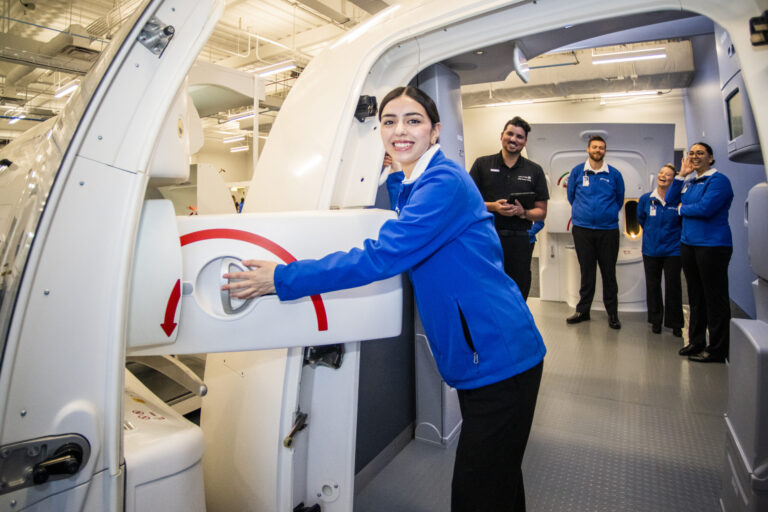
New hires will learn the base they have been assigned during their first week of training at United’s training center in Houston. United only assigns new-hire flight attendants to its domestic hub bases, as international and satellite bases don’t have on-site supervisors.
Which bases you end up being assigned will depend on the airline’s needs at the time that your training course starts, so no matter how much you want to work at a specific base, it might not even be an option for your training course.
You are not guaranteed your first-choice base. After training, you can request a transfer once you’ve completed your six-month probationary period, but transfers are awarded based on company need and in seniority order.
Worth knowing: Base size and base seniority are two different things, and confusing them is one of the most common mistakes new hires make. A large base with a lot of senior crew already anchored there could be much harder to build a good line at than a smaller base. Total lineholder count tells you scale, not necessarily how junior-friendly a base actually is.
Base by Base Overview
Ranked by total lineholder count for the August 2026 bid period, largest to smallest. As above, this reflects lineholder positions specifically, not the confirmed total base headcount.
United currently has seven main hubs across the United States:
- Newark Liberty International Airport (EWR)
- San Francisco International Airport (SFO)
- Chicago O’Hare (ORD)
- Washington Dulles (IAD)
- Houston George Bush Intercontinental (IAH)
- Denver International Airport (DEN)
- Los Angeles International Airport (LAX)
United also operates international crew bases in Guam (GUM) and London Heathrow (LHR). These bases are not, however, open to new hires and transfers to these bases are very rare.
EWR, Newark, New Jersey: United’s largest base by total lineholders in this snapshot: 2,341 international lineholders and 2,252 domestic, a combined total of 4,593 lineholders. It’s also the base showing the most dramatic movement month to month, gaining 62 international lineholder positions while losing 25 domestic ones between July and August. Newark is United’s primary transatlantic gateway, so the international side of this base carries real weight. Cost of living in the New York metro area is incredibly high, and Newark currently operates under an FAA capacity constraint.
SFO, San Francisco, California: United’s primary transpacific gateway, with extensive Asia flying alongside domestic service. The base has roughly 5,080 total active flight attendants (including language-qualified crew and international pursers), but only around 3,584 currently hold a line (1,335 domestic, 2,249 international). The gap of around 1,500 crew not currently holding a line is one of the clearest real illustrations available of how large a base’s Reserve pool can be relative to its lineholder count. The cost of living in the Bay Area is among the highest of any of United Airlines’ bases.
ORD, Chicago O’Hare, Illinois: United’s largest hub by overall network scale and the airline’s headquarters city. There were 2,681 standard lineholders (2,023 domestic, 658 international) in the August 2026 big package, with a further 115 international purser lineholder positions reported separately, with a real mix of domestic and international flying. ORD’s actual base population, including Reserve, LOD, and purser crew combined, is considerably larger than this lineholder count alone suggests. Chicago’s cost of living sits in the moderate range for a major US hub city.
IAD, Washington Dulles, Virginia: A major Star Alliance international gateway with heavy flying into Africa, the Middle East, and India alongside domestic service. Total lineholders are stated at 2,088 (849 domestic, 1,017 international). The cost of living in the Washington DC metro remains high.
IAH, Houston, Texas: Also home to United’s flight training facility, so IAH sees every new hire pass through, even if they’re not based there. There were 1,928 standard lineholders (1,423 domestic, 505 international) in the August 2026 bid package, with a further 98 international purser lineholder positions reported separately, and a modest decline in both domestic and non-purser international positions month to month, while purser positions grew slightly. The base has extensive Latin America flying alongside domestic service. Houston’s cost of living is notably lower than most of United’s other major bases.
DEN, Denver, Colorado: 1,428 total lineholders (1,189 domestic, 239 international), predominantly a domestic and Mountain West-focused base with a smaller international component than United’s coastal gateways. Denver’s cost of living has risen in recent years but generally remains below United’s coastal bases.
LAX, Los Angeles, California: 1,390 total lineholders (728 domestic, 662 international), and, like EWR/LGA, showing a clear split in its monthly trajectory: international lineholder positions grew by 11 while domestic positions fell by 33 over the same period. LAX is United’s other major Pacific gateway alongside SFO, with substantial Asia flying as well as Latin America and domestic transcontinental routes. Los Angeles carries a high cost of living, broadly comparable to United’s other coastal bases.
Understanding Seniority and Holding a Line
“Holding a line” means you have a fixed, published monthly schedule awarded through bidding, rather than sitting Reserve and waiting to be assigned trips with short notice. SFO’s numbers above are the clearest illustration available in this data: of roughly 5,080 active flight attendants based there, only around 3,584 currently hold a line. The rest are on Reserve or in another non-lineholding status.
Seniority is airline-wide, not base-specific. Moving to a different base doesn’t reset your seniority number, but it doesn’t transfer an advantage either; your position relative to everyone else already at that base determines whether you can hold a line there or sit Reserve. A base with a smaller, less entrenched senior population can mean coming off Reserve faster than a larger base with a deep bench of senior crew already holding the best lines.
Commuting: The Practical Reality
Due to the cost of living in the metro areas where airline hubs are based, a significant proportion of US flight attendants don’t live in their base city and commute the day before or the morning of a trip starting. You’ll be using your non-rev privileges to commute on a space-available basis, either on a United Airlines plane or another carrier with reciprocal travel benefits.
Commuting comes with a very obvious risk: if your commuting flight is full, delayed, or cancelled, you might not be able to get to your base in time for the start of your trip. Thankfully, United’s flight attendant contract has commuter protection built in.
Worth Knowing: If your commute is disrupted by something outside your control, such as weather, mechanical issues, or no available seat, and you follow the required notification process, you are treated as having an authorized absence rather than facing discipline. That protection holds as long as it does not become a repeated pattern.
Can You Move Bases Later?
Base transfers are governed by the same seniority bidding principle as everything else. Moving to a large, senior base with lots of veteran crew members can take a long time, since you’re competing against everyone senior to you who wants the same spot.
United’s own rule is clear regardless of destination: transfer requests are only considered after your six-month probationary period is complete, and are awarded based on company need and in seniority order, not simply on request order.
This page is part of our ongoing coverage of United Airlines flight attendant recruitment, built from close tracking of the airline's hiring process and what candidates can expect at each stage. If you're getting ready to apply, here's where to go next.