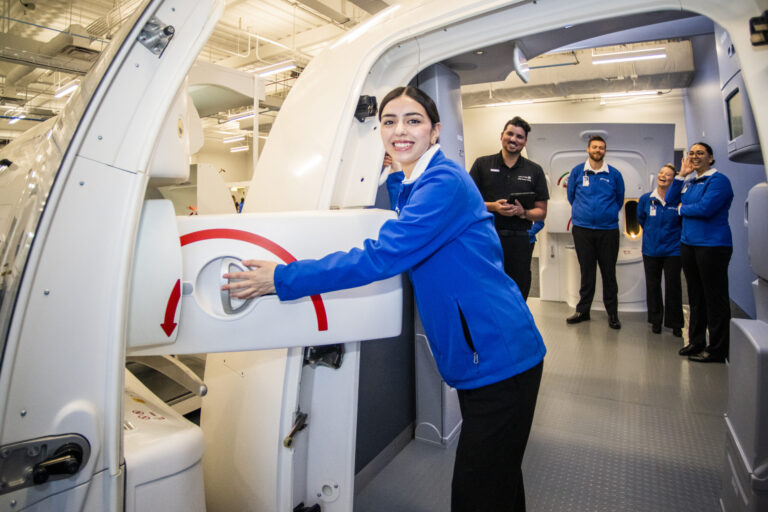


You’ve made it past the Talent Assessment. The pre-recorded interview went well, and now you’re in the live virtual interview, or perhaps even sitting across from a recruiter in Houston. The questions sound almost conversational: “Tell me about a time you demonstrated dependability.” Nothing about it sounds like a trick.
And yet this is exactly where well-prepared candidates still stumble. Not because they lack the right experience, but because they don’t realise every question in this part of the process is quietly scored against a specific, named framework known as Core4. Understanding what this framework actually means, and how to structure an answer against it, is the difference between a candidate who sounds like they’re guessing and one who sounds like they’ve done the work.
What Core4 Actually Is
United defines four values, and asks every customer-facing employee and every candidate applying to become one to demonstrate them:
- Safe: “We protect ourselves, each other, and our customers from any harm.” United makes it explicit that safety is the first priority, ahead of the other three.
- Caring: “We show that United appreciates everyone by being welcoming, kind, and compassionate with our customers and fellow employees.”
- Dependable: “We develop trust by being reliable and consistent with the quality of our performance.”
- Efficient: “We create excellence by conducting ourselves in an organized and effective way.”
Core4 isn’t a framework that United invented for recruitment marketing. It dates to 2018 when it was introduced in the aftermath of the widely publicised incident in which a passenger was dragged from a United flight.
How This Shows Up at Other Airlines
United isn’t unusual in scoring candidates against a named values framework. Several other major carriers run on a similar structure:
- JetBlue was built on five founding values chosen before the airline had a single aircraft in the air: Safety, Caring, Integrity, Passion, and Fun.
- Delta currently states its core values as Care, Integrity, Resilience, and Servant Leadership.
- Southwest runs on three values: Warrior Spirit, Servant’s Heart, and Fun-LUVing Attitude.
There is a consistent pattern across nearly every major international airline. Safety comes first and foremost, followed by values that encompass care and customer service, resilience, teamwork, and integrity.
Behavioural and Competency Questions: What to Expect
United’s interviewers ask two related but distinct kinds of questions:
Behavioural questions ask about a specific past event, and are often phrased directly around a Core4 value: “Tell me about a time you demonstrated our Core4 value of being Safe,” or “Give me an example of when you were Dependable under pressure.” These are asking for a real-life story, not a hypothetical one.
Competency-based questions ask about a skill or quality more generally, sometimes without naming Core4 explicitly at all: “Tell me about a time you had a team member unexpectedly unavailable and had to provide additional support” is really a Dependable and Efficient question. Recognising the value underneath the wording, even when it isn’t named, is a skill worth building deliberately.
Here’s roughly how each Core4 value tends to get asked about in practice:
- Safe: “Tell me about a time you noticed a risk and acted on it,” or “Describe a situation where you had to speak up about a safety concern.”
- Caring: “Tell me about a time you went out of your way for a customer or colleague,” or “Describe a moment you showed compassion in a difficult situation.”
- Dependable: “Tell me about a time you followed through on a commitment when it would have been easier not to,” or “Describe a time someone was counting on you and what happened.”
- Efficient: “Tell me about a time you improved how something was done,” or “Describe a situation where you had to get something right under time pressure.”
The Question That Tests All Four at Once
Some questions aren’t asking for a story at all, and don’t map to a single Core4 value the way the questions above do. “What do you think the role of a flight attendant is?” is the clearest example. There’s no situation to recall here; it’s a definitional question, asking whether you understand the job’s actual priority order, not whether you can recount a past event.
This matters because it’s also one of the easiest questions to answer badly without realising it. A candidate who answers purely around service has just described a role with no Safe value in it at all. That’s a red flag to an interviewer listening for Core4 alignment, even though nothing about the answer sounds wrong on its own terms.
A strong answer mirrors United’s own stated hierarchy rather than a candidate’s instinctive one. Lead with the safety responsibilities, emergency procedures, evacuations, medical situations, security awareness, before moving to the caring, service-oriented side of the role. Then, briefly, note that doing this well and consistently, across every flight, in an organised way, is what Dependable and Efficient actually look like in practice. You don’t need to name all four values explicitly, but a strong answer should be structured so that all four are recognisably present, in the right order, without being asked about individually.
How to Answer: Using SOAR for Core4
United recommends that candidates answer questions using the STAR framework: Situation, Task, Actions, Result.
We prefer an ever-so-slight variation of this framework called SOAR: Situation, Objective, Actions, Result. Replacing Task with Objective allows you to identify the issue and act to resolve it, rather than just completing a job task. If you want to know more about how this framework works in practice, then check out our full guide: SOAR to Success.
As a quick example, here’s two different ways to answer a question about Dependability.
Weak version:
“I was working at a retail job and a coworker called in sick during a busy weekend. My task was to cover extra shifts. I picked up the hours, and everything went fine.”
SOAR version:
Situation: “I was working a retail job during our busiest weekend of the year when a coworker called in sick with no notice.”
Objective: “I could see this wasn’t just an inconvenience; it meant the whole team would be stretched thin at exactly the moment customers needed the most help. My objective was to make sure the team held together without anyone else feeling like they had to silently absorb the gap.”
Actions: “I picked up the extra shifts myself, but I also flagged to my manager early that we’d need cover for the following weekend too, rather than waiting for it to become a crisis again. I regularly checked in with the rest of the team throughout to see who was struggling, and offered my support.”
Result: “By the end of the weekend, we’d hit our sales targets despite being short-staffed, and my manager specifically mentioned it in my next review.”
The weak version answers the question. The SOAR version actually demonstrates Dependable.
Building the Objective Around the Right Value
By identifying the Objective, you can build your answer around the different Core4 values. Before describing what you did, name what you were actually trying to achieve, and frame it around the value the question is aimed at:
- If the question is aimed at Safe, your objective should be framed around protecting someone from harm or risk, not just solving a problem.
- If the question is aimed at Caring, your objective should be framed around making someone feel genuinely looked after, not just satisfied.
- If the question is aimed at Dependable, your objective should be framed around consistency and follow-through, not just getting the immediate task done.
- If the question is aimed at Efficient, your objective should be framed around doing something in an organised, effective way, not just getting it finished.
The same base story can often serve more than one value. It all just depends on how you frame the objective. The retail example above could just as easily demonstrate Efficient if the objective was reframed around organising the schedule gap effectively, rather than around personal reliability.
This is exactly why preparing five or six strong examples in advance, rather than a different story for every possible question works so well – you just have to adapt the objective, not the whole story.
Insight: Airline recruiters are looking for answers that are structured around STAR or SOAR. Make their job easier by following this framework. Answering a question outside of this framework won’t make you stand out in a good way.
Preparing Before Your Interview
Go through the four Core4 values and, for each one, write down one real example from your own experience, using the SOAR headings as bullet points before you try to say it out loud. Don’t default to your strongest story for every value, a common mistake is having one excellent Caring example and trying to stretch it to cover Dependable and Efficient too.
Pay particular attention to Dependable and Efficient. Most candidates over-prepare for Caring, since it’s the value that feels most natural to talk about, and under-prepare for the other two, which is exactly why a strong, specific Dependable or Efficient example often lands better in the room because it doesn’t sound like everyone else’s answer.
Practise saying your answers out loud, not reading from notes.
A Final Word
Core4 isn’t a trick, and it isn’t designed to catch you out. It’s the actual criteria United is using to decide who they want representing the airline in an emergency, a delay, or an ordinary Tuesday flight. Knowing the four words is the easy part. Structuring a real, honest answer that demonstrates one of them clearly, without ever needing to say which one, is what actually gets you through the room.
For the full breakdown of every stage of United’s process, see our Step-By-Step United Airlines Flight Attendant Recruitment guide, or check out our guide to United’s pay and benefits.